
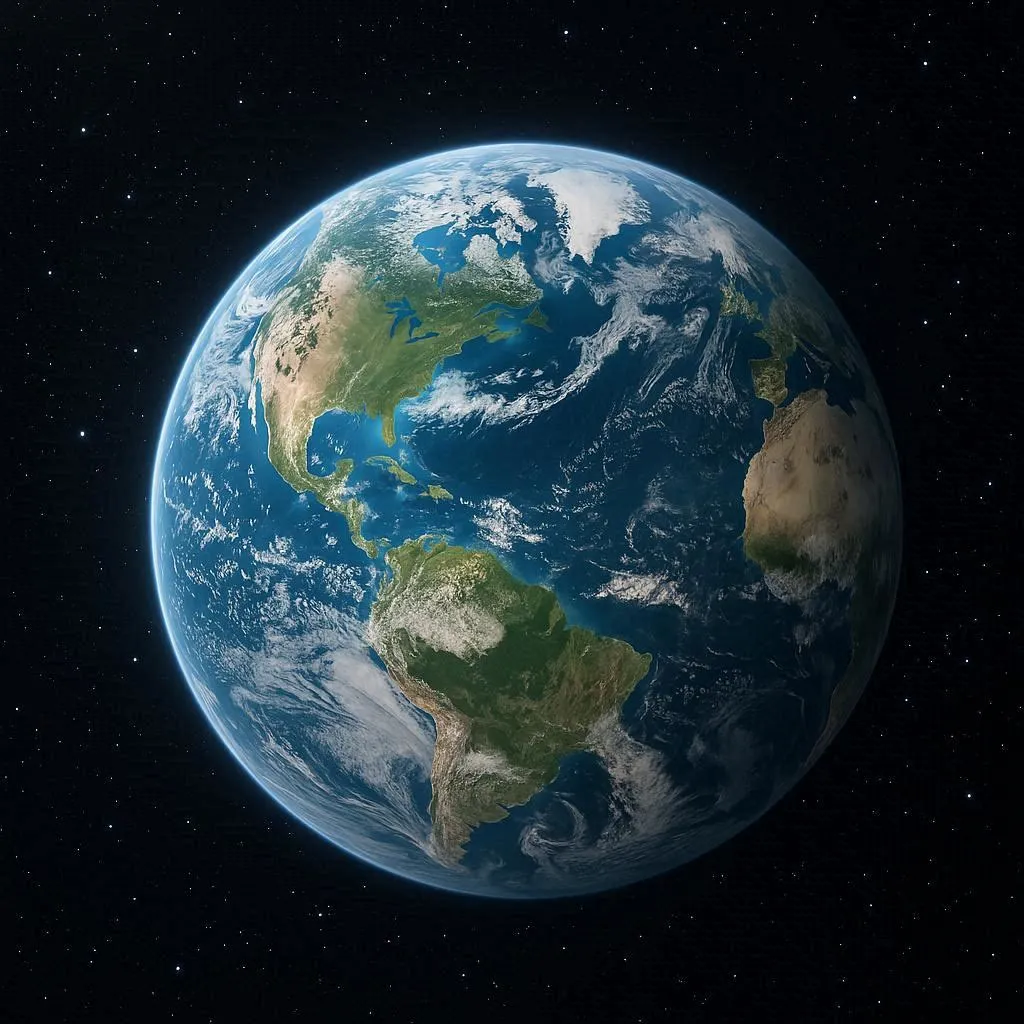
Time to get down to Earth literally! Our Earth Trivia Questions and Answers are here to test your knowledge about the amazing planet we call home.
From jaw-dropping natural wonders to mind-blowing facts about oceans, mountains, and everything in between, this trivia is packed with fun and discovery.
Whether you’re a geography geek, a nature nerd, or just curious about the world beneath your feet, these questions will keep you grounded and entertained.
Ready to see how well you really know Planet Earth? Let’s dig in!
Earth Science Trivia Questions and Answers
1. What is the third planet from the Sun?
Answer: Earth.
Explanation: Earth is the third planet in our solar system, after Mercury and Venus.
Key Information: Earth is the only known planet with life.
2. What is Earth’s natural satellite called?
Answer: The Moon.
Explanation: The Moon orbits Earth and is the brightest natural object in our night sky.
Key Information: The Moon influences ocean tides on Earth.
3. What is the largest ocean on Earth?
Answer: The Pacific Ocean.
Explanation: The Pacific covers more area than any other ocean.
Key Information: It stretches between Asia, Australia, and the Americas.
4. What is the largest continent on Earth?
Answer: Asia.
Explanation: Asia is the largest continent by both area and population.
Key Information: It contains dozens of countries and diverse climates.
5. What is the highest mountain above sea level?
Answer: Mount Everest.
Explanation: Mount Everest rises to about 8,849 meters above sea level.
Key Information: It is located in the Himalayas on the Nepal-China border.
6. What is the largest desert on Earth?
Answer: Antarctica.
Explanation: Antarctica is classified as a desert because it receives very little precipitation.
Key Information: It is the largest desert and the coldest continent.
7. What percentage of Earth’s surface is covered by water?
Answer: About 71%.
Explanation: Oceans, seas, lakes, rivers, and other bodies of water cover most of Earth’s surface.
Key Information: The remaining roughly 29% is land.
8. What layer surrounds Earth and contains the air we breathe?
Answer: The atmosphere.
Explanation: Earth’s atmosphere is a mixture of gases surrounding the planet.
Key Information: Nitrogen and oxygen make up most of the atmosphere.
9. What gas makes up the largest portion of Earth’s atmosphere?
Answer: Nitrogen.
Explanation: Nitrogen accounts for about 78% of dry air.
Key Information: Oxygen makes up about 21%.
10. What force keeps us on the surface of Earth?
Answer: Gravity.
Explanation: Earth’s gravity pulls objects toward its center.
Key Information: Gravity also keeps the Moon in orbit around Earth.
11. What is Earth’s solid outer layer called?
Answer: The crust.
Explanation: The crust is the thin outermost solid layer of Earth.
Key Information: Earth’s crust is divided into tectonic plates.
12. What causes earthquakes?
Answer: Sudden movements in Earth’s crust and tectonic plates.
Explanation: Stress can build along faults until rocks suddenly move and release energy.
Key Information: Earthquakes can occur both on land and beneath oceans.
13. What is the process by which water moves between Earth’s surface and atmosphere?
Answer: The water cycle.
Explanation: Water evaporates, condenses, falls as precipitation, and moves through the environment.
Key Information: The water cycle continuously recycles Earth’s water.
14. What is the longest mountain range on land?
Answer: The Andes.
Explanation: The Andes stretch along the western side of South America.
Key Information: They extend through several countries.
15. What is the deepest ocean trench on Earth?
Answer: The Mariana Trench.
Explanation: It is located in the western Pacific Ocean and contains Earth’s deepest known point.
Key Information: Challenger Deep is the deepest known area of the trench.
16. What is the deepest known point in Earth’s oceans called?
Answer: Challenger Deep.
Explanation: Challenger Deep lies within the Mariana Trench.
Key Information: It is nearly 11 kilometers below sea level.
17. Why does Earth have different seasons?
Answer: Because Earth’s axis is tilted as it orbits the Sun.
Explanation: The tilt changes how directly sunlight reaches different parts of Earth during the year.
Key Information: Earth’s axial tilt is about 23.5 degrees.
18. How long does Earth take to orbit the Sun?
Answer: About 365.25 days.
Explanation: This period is called a year.
Key Information: The extra quarter day is why leap years are needed.
19. How long does Earth take to rotate once on its axis?
Answer: About 24 hours.
Explanation: Earth’s rotation produces the cycle of day and night.
Key Information: A solar day is approximately 24 hours long.
20. What protects Earth from much of the Sun’s harmful ultraviolet radiation?
Answer: The ozone layer.
Explanation: Ozone in the stratosphere absorbs a large portion of harmful ultraviolet radiation.
Key Information: The ozone layer is an important part of Earth’s atmospheric protection.
Recommended: 136+ Exciting Earth Day Trivia Questions and Answers
Earth Day Trivia Questions and Answers
1. What is the largest country on Earth by area?
Answer: Russia.
Explanation: Russia covers a vast area across eastern Europe and northern Asia.
Key Information: It spans 11 time zones.
2. What is the smallest country on Earth?
Answer: Vatican City.
Explanation: Vatican City is a tiny independent country located within Rome, Italy.
Key Information: It is also the world’s smallest country by population.
3. What is the largest island on Earth?
Answer: Greenland.
Explanation: Greenland is the world’s largest island that is not considered a continent.
Key Information: It is geographically part of North America.
4. What is the largest rainforest on Earth?
Answer: The Amazon Rainforest.
Explanation: It covers a huge area across South America and contains extraordinary biodiversity.
Key Information: Most of the Amazon Rainforest lies within Brazil.
5. Which river is generally recognized as the longest river in the world?
Answer: The Nile River.
Explanation: The Nile flows northward through northeastern Africa.
Key Information: The exact ranking between the Nile and Amazon can depend on how river length is measured.
6. What is the largest hot desert on Earth?
Answer: The Sahara Desert.
Explanation: The Sahara covers much of North Africa and is the largest hot desert.
Key Information: It covers roughly 9 million square kilometers.
7. What is the coldest continent on Earth?
Answer: Antarctica.
Explanation: Antarctica has an extremely cold climate and is covered by a massive ice sheet.
Key Information: It is also the driest continent.
8. What is the largest animal on Earth?
Answer: The blue whale.
Explanation: Blue whales can reach enormous lengths and weights.
Key Information: They are the largest animals known to have ever lived.
9. What is the fastest land animal?
Answer: The cheetah.
Explanation: Cheetahs can reach very high speeds over short distances.
Key Information: They are built for acceleration rather than long-distance running.
10. What is the largest living land animal?
Answer: The African elephant.
Explanation: African elephants are the largest land animals alive today.
Key Information: Adult males can weigh several tons.
11. What is the largest living bird?
Answer: The ostrich.
Explanation: Ostriches are the tallest and heaviest living birds.
Key Information: They cannot fly but are excellent runners.
12. What is the deepest lake in the world?
Answer: Lake Baikal.
Explanation: Lake Baikal in Russia reaches a depth of about 1,642 meters.
Key Information: It contains a significant share of the world’s unfrozen surface freshwater.
13. What is the largest lake by surface area?
Answer: The Caspian Sea.
Explanation: Despite its name, the Caspian Sea is an enclosed body of water and is classified as the world’s largest lake by surface area.
Key Information: It lies between Europe and Asia.
14. What is the longest mountain range on Earth?
Answer: The mid-ocean ridge system.
Explanation: This enormous underwater mountain system stretches around much of the planet.
Key Information: Most of it is hidden beneath the oceans.
15. What is the largest coral reef system on Earth?
Answer: The Great Barrier Reef.
Explanation: It consists of thousands of reefs and hundreds of islands off northeastern Australia.
Key Information: It is visible from space in broad satellite views.
16. What causes tides on Earth?
Answer: Mainly the gravitational pull of the Moon and the Sun.
Explanation: Their gravity causes ocean water to bulge and move in regular cycles.
Key Information: The Moon has the stronger effect on Earth’s tides.
17. What is Earth’s inner core mainly made of?
Answer: Iron and nickel.
Explanation: The inner core is a solid metal region deep inside Earth.
Key Information: Extremely high pressure keeps it solid despite its very high temperature.
18. What causes volcanic eruptions?
Answer: The movement of magma and gases from inside Earth toward the surface.
Explanation: Pressure can force molten rock and gases through weaknesses in Earth’s crust.
Key Information: Volcanoes are strongly associated with tectonic activity.
19. What is the name of the supercontinent that existed millions of years ago?
Answer: Pangaea.
Explanation: Pangaea was a massive landmass that later broke apart into continents.
Key Information: Continental movement is explained by plate tectonics.
20. What is the main source of energy for life on Earth?
Answer: The Sun.
Explanation: Sunlight provides energy for photosynthesis, which supports most major food webs.
Key Information: Solar energy also drives Earth’s weather and climate systems.
Related: 161+ Epic Lord of the Rings Trivia Questions and Answers
Earth Trivia Questions and Answers for Kids
1. What is Earth’s largest continent by land area?
Answer: Asia.
Explanation: Asia covers more land than any other continent.
Key Information: It is also home to more than half of the world’s population.
2. What is the smallest continent by land area?
Answer: Australia.
Explanation: Australia is the smallest of the seven commonly recognized continents.
Key Information: Australia is also the name of the country occupying most of the continent.
3. What is the largest ocean on Earth?
Answer: The Pacific Ocean.
Explanation: The Pacific is larger than all of Earth’s land areas combined.
Key Information: It covers more than 160 million square kilometers.
4. Which ocean is the smallest?
Answer: The Arctic Ocean.
Explanation: The Arctic Ocean is the smallest and shallowest of the five major oceans.
Key Information: Much of it is covered by sea ice during the year.
5. What is the highest waterfall on Earth?
Answer: Angel Falls.
Explanation: Angel Falls in Venezuela has a total height of about 979 meters.
Key Information: Its uninterrupted drop is about 807 meters.
6. What is the largest volcano on Earth by volume?
Answer: Mauna Loa.
Explanation: Mauna Loa is a massive shield volcano on Hawaii’s Big Island.
Key Information: Much of the volcano extends below sea level.
7. What is the largest active volcano on Earth?
Answer: Mauna Loa.
Explanation: Mauna Loa is one of the most massive active volcanoes on Earth.
Key Information: It has erupted many times in recorded history.
8. What is the largest land animal in Africa?
Answer: The African elephant.
Explanation: African elephants are the largest living terrestrial mammals.
Key Information: Their large ears help them release body heat.
9. Which animal is known as the fastest bird in a dive?
Answer: The peregrine falcon.
Explanation: During a hunting dive, it can reach speeds exceeding 300 kilometers per hour.
Key Information: This makes it the fastest known animal in the world during a dive.
10. What is the largest living reptile?
Answer: The saltwater crocodile.
Explanation: Adult males can grow to exceptional lengths and weights.
Key Information: It lives in coastal and freshwater areas of South and Southeast Asia and northern Australia.
11. What is the largest fish in the world?
Answer: The whale shark.
Explanation: Whale sharks are enormous filter-feeding fish.
Key Information: Despite their name and size, they are fish rather than whales.
12. What is the largest rainforest in the world by area?
Answer: The Amazon Rainforest.
Explanation: It covers a vast region of South America.
Key Information: It contains an extraordinary variety of plants and animals.
13. What is the largest desert on Earth by total area?
Answer: Antarctica.
Explanation: Antarctica qualifies as a desert because of its extremely low precipitation.
Key Information: It is the world’s largest cold desert.
14. What is the largest hot desert in the world?
Answer: The Sahara Desert.
Explanation: The Sahara occupies much of northern Africa.
Key Information: It is larger than the continental United States.
15. What is the longest river in South America?
Answer: The Amazon River.
Explanation: The Amazon carries more water than any other river on Earth.
Key Information: It flows through several South American countries.
16. What is the largest freshwater lake by surface area?
Answer: Lake Superior.
Explanation: Lake Superior is the largest freshwater lake by surface area.
Key Information: It borders the United States and Canada.
17. What is the deepest point in the ocean called?
Answer: Challenger Deep.
Explanation: Challenger Deep is located in the Mariana Trench in the western Pacific Ocean.
Key Information: It reaches nearly 11 kilometers below sea level.
18. What is the name of Earth’s protective magnetic field?
Answer: The magnetosphere.
Explanation: Earth’s magnetic field creates a region around the planet that helps deflect charged particles from the solar wind.
Key Information: It also plays a role in producing auroras.
19. What natural phenomenon creates the northern lights?
Answer: Interactions between charged solar particles and Earth’s atmosphere.
Explanation: Energetic particles excite gases high in the atmosphere, producing glowing colors.
Key Information: The northern lights are called aurora borealis.
20. What natural phenomenon is the southern counterpart of the northern lights?
Answer: Aurora australis.
Explanation: Aurora australis occurs around the southern polar regions.
Key Information: Both auroras are caused by interactions involving the solar wind and Earth’s magnetic field.
Planet Earth Trivia Questions and Answers
1. What is the largest country in Africa by area?
Answer: Algeria.
Explanation: Algeria covers a vast area in northern Africa.
Key Information: It is also the largest country in Africa by land area.
2. What is the smallest country in Africa by area?
Answer: Seychelles.
Explanation: Seychelles is an island country in the Indian Ocean.
Key Information: It consists of many islands northeast of Madagascar.
3. Which country has the longest coastline in the world?
Answer: Canada.
Explanation: Canada has an enormous coastline along the Atlantic, Pacific, and Arctic Oceans.
Key Information: Its coastline is longer than that of any other country.
4. What is the largest peninsula on Earth?
Answer: The Arabian Peninsula.
Explanation: It is a huge landmass surrounded by water on three sides.
Key Information: It includes countries such as Saudi Arabia, Yemen, Oman, and the United Arab Emirates.
5. What is the largest bay in the world?
Answer: The Bay of Bengal.
Explanation: The Bay of Bengal is a large body of water in the northeastern Indian Ocean.
Key Information: It borders India, Bangladesh, Myanmar, and Sri Lanka.
6. What is the largest gulf in the world?
Answer: The Gulf of Mexico.
Explanation: The Gulf of Mexico is a major ocean basin surrounded by parts of North America and the Caribbean region.
Key Information: It connects with the Atlantic Ocean through the Florida Straits and Caribbean Sea.
7. What is the largest island in the Mediterranean Sea?
Answer: Sicily.
Explanation: Sicily is a large Italian island located south of the Italian mainland.
Key Information: Mount Etna, one of Europe’s most active volcanoes, is located there.
8. What is the largest island in the Caribbean?
Answer: Cuba.
Explanation: Cuba is the largest island in the Caribbean Sea.
Key Information: Its capital is Havana.
9. What is the longest continental mountain range?
Answer: The Andes.
Explanation: The Andes extend along the western edge of South America.
Key Information: They pass through several countries, including Chile, Argentina, Peru, and Bolivia.
10. What is the highest mountain outside Asia?
Answer: Aconcagua.
Explanation: Aconcagua rises to about 6,961 meters in the Andes.
Key Information: It is located in Argentina.
11. What is the lowest exposed land point on Earth?
Answer: The shore of the Dead Sea.
Explanation: The Dead Sea lies hundreds of meters below sea level.
Key Information: Its shoreline elevation changes over time as the water level changes.
12. What is the largest salt flat in the world?
Answer: Salar de Uyuni.
Explanation: This enormous salt flat covers a large area of southwestern Bolivia.
Key Information: It can create spectacular mirror-like reflections when covered by a thin layer of water.
13. What is the largest cave system known for its enormous passages in Vietnam?
Answer: Son Doong Cave.
Explanation: Son Doong is famous for its exceptionally large chambers and passages.
Key Information: It is part of Phong Nha-Ke Bang National Park.
14. What is the largest coral reef system in the world?
Answer: The Great Barrier Reef.
Explanation: It consists of thousands of individual reefs and hundreds of islands.
Key Information: It lies off the northeastern coast of Australia.
15. What is the largest freshwater island in the world?
Answer: Manitoulin Island.
Explanation: Manitoulin Island is located in Lake Huron in Canada.
Key Information: It contains numerous lakes of its own.
16. What is the largest inland body of water on Earth?
Answer: The Caspian Sea.
Explanation: Despite being called a sea, it is commonly classified as the world’s largest lake by surface area.
Key Information: It is surrounded by five countries.
17. Which continent contains the most countries?
Answer: Africa.
Explanation: Africa has more internationally recognized sovereign states than any other continent.
Key Information: The exact count can vary depending on how territories and disputed states are classified.
18. Which continent has no permanent native human population?
Answer: Antarctica.
Explanation: Antarctica has research stations but no permanent indigenous population.
Key Information: Scientists and support staff live there temporarily or seasonally.
19. What is the largest ice sheet on Earth?
Answer: The Antarctic Ice Sheet.
Explanation: It covers most of the Antarctic continent.
Key Information: It contains the vast majority of Earth’s freshwater ice.
20. What is the deepest freshwater lake on Earth?
Answer: Lake Baikal.
Explanation: Lake Baikal in Siberia reaches a depth of about 1,642 meters.
Key Information: It is also one of the world’s oldest freshwater lakes.
Read More : 218+ Nail-Biting Construction Trivia Questions
Easy Earth Trivia Questions and Answers
1. What is the hottest planet in our solar system?
Answer: Venus.
Explanation: Venus has a very thick carbon dioxide atmosphere that traps heat.
Key Information: Its surface is hotter than Mercury’s despite being farther from the Sun.
2. What is the largest planet in our solar system?
Answer: Jupiter.
Explanation: Jupiter is the largest planet by both diameter and mass.
Key Information: More than 1,300 Earths could fit inside it by volume.
3. What is the smallest planet in our solar system?
Answer: Mercury.
Explanation: Mercury is the smallest of the eight recognized planets.
Key Information: It is also the planet closest to the Sun.
4. Which planet is known as the Red Planet?
Answer: Mars.
Explanation: Iron minerals on Mars have oxidized, giving its surface a reddish appearance.
Key Information: Mars has two small moons, Phobos and Deimos.
5. Which planet is famous for its prominent ring system?
Answer: Saturn.
Explanation: Saturn’s rings are made mostly of ice particles, dust, and rocky material.
Key Information: The rings contain countless individual pieces of material.
6. What is the only known astronomical body where life exists?
Answer: Earth.
Explanation: Earth has liquid water, a suitable atmosphere, and conditions that support life.
Key Information: No confirmed extraterrestrial life has been discovered.
7. What is Earth’s approximate age?
Answer: About 4.54 billion years.
Explanation: Scientists estimate Earth’s age using radiometric dating of rocks and meteorites.
Key Information: Earth formed during the early history of the solar system.
8. What is the largest ocean on Earth?
Answer: The Pacific Ocean.
Explanation: The Pacific covers the greatest area of Earth’s oceans.
Key Information: It contains the Mariana Trench, the deepest known part of the ocean.
9. What is the longest river in Europe?
Answer: The Volga River.
Explanation: The Volga flows through western Russia before reaching the Caspian Sea.
Key Information: It is entirely within Russia.
10. What is the highest waterfall in South America?
Answer: Angel Falls.
Explanation: Angel Falls drops about 979 meters from the summit of Auyán-tepui in Venezuela.
Key Information: It is the world’s highest uninterrupted waterfall.
11. What is the largest peninsula in Europe?
Answer: The Scandinavian Peninsula.
Explanation: It includes most of Norway and Sweden and part of northern Finland.
Key Information: It is one of Europe’s largest geographical peninsulas.
12. What is the largest lake in Africa?
Answer: Lake Victoria.
Explanation: Lake Victoria is the largest lake in Africa by surface area.
Key Information: It is shared by Tanzania, Uganda, and Kenya.
13. What is the deepest lake in Africa?
Answer: Lake Tanganyika.
Explanation: Lake Tanganyika reaches depths of more than 1,400 meters.
Key Information: It is one of the world’s deepest and oldest freshwater lakes.
14. What is the largest active volcano in Europe?
Answer: Mount Etna.
Explanation: Mount Etna is an active volcano on Sicily, Italy.
Key Information: It has erupted repeatedly throughout recorded history.
15. What is the driest non-polar desert on Earth?
Answer: The Atacama Desert.
Explanation: Parts of the Atacama receive extremely little rainfall.
Key Information: It is located mainly in northern Chile.
16. What is the longest cave system known in the world?
Answer: Mammoth Cave system.
Explanation: Mammoth Cave in Kentucky, United States, contains hundreds of kilometers of surveyed passages.
Key Information: New passages can still be discovered and mapped.
17. What is the largest delta in the world?
Answer: The Ganges-Brahmaputra-Meghna Delta.
Explanation: This enormous delta spreads across Bangladesh and parts of India.
Key Information: It is one of the most densely populated delta regions on Earth.
18. What is the highest plateau in the world?
Answer: The Tibetan Plateau.
Explanation: The Tibetan Plateau has an average elevation of roughly 4,500 meters.
Key Information: It is often called the “Roof of the World.”
19. What is the largest bay in the world?
Answer: The Bay of Bengal.
Explanation: It is a vast bay in the northeastern Indian Ocean.
Key Information: Major rivers including the Ganges and Brahmaputra drain into it.
20. What is the largest rainforest outside South America?
Answer: The Congo Basin rainforest.
Explanation: It covers a huge area across Central Africa.
Key Information: It is the second-largest tropical rainforest in the world after the Amazon.
Hard Earth Trivia Questions and Answers
1. What is the deepest ocean on Earth?
Answer: The Pacific Ocean.
Explanation: The Pacific contains the Mariana Trench, the deepest known part of the global ocean.
Key Information: Challenger Deep is located within the Mariana Trench.
2. What is the largest ocean by volume?
Answer: The Pacific Ocean.
Explanation: Its enormous surface area and great depth make it the largest ocean by volume.
Key Information: It holds a substantial portion of Earth’s ocean water.
3. What is the largest country in South America?
Answer: Brazil.
Explanation: Brazil occupies nearly half of South America’s land area.
Key Information: It is also the fifth-largest country in the world by area.
4. What is the smallest country in South America?
Answer: Suriname.
Explanation: Suriname has the smallest land area among the sovereign countries of South America.
Key Information: It is located on the continent’s northeastern coast.
5. What is the largest country in Asia by area?
Answer: Russia.
Explanation: Russia stretches across northern Asia and eastern Europe.
Key Information: Its Asian portion makes up a large share of the country’s territory.
6. What is the largest country entirely in Asia?
Answer: China.
Explanation: China is the largest country whose territory lies entirely within Asia.
Key Information: It is also one of the world’s most populous countries.
7. What is the largest country in Europe by area?
Answer: Russia.
Explanation: Russia extends across both Europe and Asia.
Key Information: Its European portion is larger than any other European country.
8. What is the largest country entirely within Europe?
Answer: Ukraine.
Explanation: Ukraine is the largest sovereign state located entirely in Europe.
Key Information: Russia is larger but spans both Europe and Asia.
9. What is the largest country in North America?
Answer: Canada.
Explanation: Canada covers a huge area stretching from the Atlantic to the Pacific and Arctic Oceans.
Key Information: It is the second-largest country in the world by total area.
10. What is the largest country in Africa by population?
Answer: Nigeria.
Explanation: Nigeria has the largest population of any African country.
Key Information: It is located on the Gulf of Guinea in West Africa.
11. What is the largest island in Africa?
Answer: Madagascar.
Explanation: Madagascar is a large island nation located off Africa’s southeastern coast.
Key Information: It is famous for its unique wildlife, including lemurs.
12. What is the largest lake in South America?
Answer: Lake Maracaibo.
Explanation: Lake Maracaibo is a large body of water in Venezuela connected to the Caribbean Sea.
Key Information: Its classification as a lake or bay can vary because of its connection to the sea.
13. What is the largest river basin in the world?
Answer: The Amazon Basin.
Explanation: The Amazon drainage basin covers a vast area of South America.
Key Information: It spans several countries, with most of it in Brazil.
14. What is the world’s largest tropical wetland?
Answer: The Pantanal.
Explanation: The Pantanal is an enormous seasonal wetland mainly located in Brazil.
Key Information: It supports an exceptional variety of wildlife.
15. What is the largest mountain system in North America?
Answer: The Rocky Mountains.
Explanation: The Rockies stretch from western Canada into the United States.
Key Information: They form an important part of North America’s western mountain landscape.
16. What is the highest mountain in Africa?
Answer: Mount Kilimanjaro.
Explanation: Kilimanjaro rises to about 5,895 meters above sea level.
Key Information: It is a volcanic mountain in Tanzania.
17. What is the highest mountain in North America?
Answer: Denali.
Explanation: Denali reaches about 6,190 meters above sea level.
Key Information: It is located in Alaska, United States.
18. What is the highest mountain in South America?
Answer: Aconcagua.
Explanation: Aconcagua reaches about 6,961 meters above sea level.
Key Information: It is located in Argentina’s Andes Mountains.
19. What is the highest mountain in Europe?
Answer: Mount Elbrus.
Explanation: Mount Elbrus rises to about 5,642 meters in the Caucasus Mountains.
Key Information: Its classification as Europe’s highest peak depends on the geographic boundary used for Europe.
20. What is the highest mountain in Oceania?
Answer: Puncak Jaya.
Explanation: Puncak Jaya, also called Carstensz Pyramid, rises to about 4,884 meters in Indonesia.
Key Information: It is located on the island of New Guinea.
Earth Trivia Questions and Answers for Students
1. What is Earth’s largest natural satellite?
Answer: The Moon.
Explanation: The Moon is the only natural satellite of Earth and is much smaller than Earth itself.
Key Information: Its gravity plays a major role in Earth’s ocean tides.
2. What is the name of Earth’s outermost atmospheric layer?
Answer: The exosphere.
Explanation: The exosphere is the highest layer of Earth’s atmosphere and gradually merges into outer space.
Key Information: Some satellites orbit within or near this region.
3. What is the lowest layer of Earth’s atmosphere?
Answer: The troposphere.
Explanation: The troposphere is the atmospheric layer closest to Earth’s surface.
Key Information: Almost all everyday weather occurs in the troposphere.
4. What atmospheric layer contains most of Earth’s ozone?
Answer: The stratosphere.
Explanation: The ozone layer is concentrated in the stratosphere above the troposphere.
Key Information: Ozone absorbs much of the Sun’s harmful ultraviolet radiation.
5. What causes the blue color of Earth’s daytime sky?
Answer: Rayleigh scattering.
Explanation: Air molecules scatter shorter wavelengths of sunlight more strongly than longer wavelengths.
Key Information: Blue light is scattered more strongly, making the sky appear blue.
6. Why can sunsets appear red or orange?
Answer: Sunlight travels through more atmosphere near the horizon.
Explanation: More scattering removes much of the blue light from the direct sunlight reaching our eyes.
Key Information: Red and orange wavelengths are more likely to remain visible.
7. What is the name of the molten rock beneath Earth’s surface?
Answer: Magma.
Explanation: Molten rock beneath Earth’s surface is called magma.
Key Information: Once it reaches the surface, it is generally called lava.
8. What is the solid outer layer of Earth made of?
Answer: Rock and minerals.
Explanation: Earth’s crust consists of many different rocks and minerals.
Key Information: Oceanic crust and continental crust have different compositions and thicknesses.
9. What is Earth’s thickest internal layer?
Answer: The mantle.
Explanation: The mantle lies between the crust and the core and makes up most of Earth’s volume.
Key Information: It consists mainly of solid rock that can slowly flow over geological timescales.
10. What is Earth’s innermost layer called?
Answer: The inner core.
Explanation: The inner core is a dense, extremely hot region at Earth’s center.
Key Information: It is primarily composed of iron and nickel.
11. What causes Earth’s magnetic field?
Answer: Movement of molten metal in the outer core.
Explanation: Convection and Earth’s rotation help generate electric currents that produce the magnetic field.
Key Information: This process is known as the geodynamo.
12. What is a tectonic plate?
Answer: A large rigid section of Earth’s lithosphere.
Explanation: Tectonic plates move slowly over the softer material beneath them.
Key Information: Their movements cause earthquakes, volcanoes, and mountain building.
13. What happens when two tectonic plates move apart?
Answer: They form a divergent boundary.
Explanation: Magma can rise into the gap and create new crust.
Key Information: Mid-ocean ridges are major examples of divergent boundaries.
14. What happens when one tectonic plate moves beneath another?
Answer: Subduction.
Explanation: The denser plate sinks into Earth’s mantle beneath the other plate.
Key Information: Subduction zones can produce powerful earthquakes and volcanoes.
15. What is the process by which rocks are broken down at Earth’s surface?
Answer: Weathering.
Explanation: Water, wind, temperature changes, and chemical reactions can break down rocks.
Key Information: Weathering contributes to soil formation.
16. What is erosion?
Answer: The movement of weathered material from one place to another.
Explanation: Wind, water, ice, and gravity can transport soil and rock particles.
Key Information: Erosion gradually shapes landscapes.
17. What is the process by which plants release water vapor into the atmosphere?
Answer: Transpiration.
Explanation: Plants release water vapor mainly through tiny openings in their leaves.
Key Information: Transpiration is an important part of the water cycle.
18. What is precipitation?
Answer: Water that falls from the atmosphere to Earth’s surface.
Explanation: Rain, snow, sleet, and hail are forms of precipitation.
Key Information: Precipitation is an important stage of the water cycle.
19. What percentage of Earth’s freshwater is frozen in glaciers and ice sheets?
Answer: About 68% of Earth’s freshwater.
Explanation: Most of Earth’s freshwater is locked away in ice.
Key Information: Only a small fraction of freshwater is readily available in rivers and lakes.
20. What is the name of the boundary between Earth’s crust and mantle?
Answer: The Mohorovičić discontinuity, or Moho.
Explanation: The Moho marks a change in seismic-wave behavior between the crust and mantle.
Key Information: It was named after Croatian seismologist Andrija Mohorovičić.
Earth Trivia Questions and Answers for Adults
1. What is the largest land mammal on Earth?
Answer: The African elephant.
Explanation: African elephants are the largest living animals that live on land.
Key Information: Adult males can weigh more than 6,000 kilograms.
2. What is the largest mammal on Earth?
Answer: The blue whale.
Explanation: Blue whales are enormous marine mammals that can grow to around 30 meters long.
Key Information: They are the largest animals known to have ever lived.
3. What is the smallest continent by land area?
Answer: Australia.
Explanation: Australia is the smallest of the seven commonly recognized continents.
Key Information: It is also the only continent that is largely occupied by a single country.
4. What is the driest continent on Earth?
Answer: Antarctica.
Explanation: Antarctica receives extremely little precipitation across much of its interior.
Key Information: Despite being covered in ice, it is classified as a desert.
5. What is the windiest continent on Earth?
Answer: Antarctica.
Explanation: Strong katabatic winds can descend from the high Antarctic interior toward the coast.
Key Information: Some Antarctic regions experience exceptionally powerful winds.
6. What is the largest continent by population?
Answer: Asia.
Explanation: Asia contains more people than any other continent.
Key Information: China and India alone account for a huge share of the continent’s population.
7. What is the most abundant gas in Earth’s atmosphere?
Answer: Nitrogen.
Explanation: Nitrogen makes up about 78% of Earth’s dry atmosphere.
Key Information: Oxygen accounts for about 21%.
8. What is the second most abundant gas in Earth’s atmosphere?
Answer: Oxygen.
Explanation: Oxygen makes up roughly 21% of dry air.
Key Information: Most animals require oxygen for cellular respiration.
9. What is the most common element in Earth’s crust by mass?
Answer: Oxygen.
Explanation: Oxygen is abundant in minerals that make up rocks in the crust.
Key Information: Silicon is the second most abundant element in the crust.
10. What is the largest ocean current on Earth?
Answer: The Antarctic Circumpolar Current.
Explanation: It flows continuously around Antarctica and connects the Atlantic, Pacific, and Indian Oceans.
Key Information: It plays an important role in global ocean circulation.
11. What is the largest living structure on Earth?
Answer: The Great Barrier Reef ecosystem.
Explanation: It is a vast network of coral reefs and associated habitats off Australia.
Key Information: It supports thousands of marine species.
12. What is the largest tropical rainforest in Africa?
Answer: The Congo Basin rainforest.
Explanation: It covers a huge area across Central Africa.
Key Information: It is the second-largest tropical rainforest region after the Amazon.
13. What is the largest desert in Asia?
Answer: The Arabian Desert.
Explanation: The Arabian Desert occupies much of the Arabian Peninsula.
Key Information: It includes vast areas of Saudi Arabia, Oman, Yemen, and neighboring countries.
14. What is the largest desert in Australia?
Answer: The Great Victoria Desert.
Explanation: It stretches across large parts of Western Australia and South Australia.
Key Information: It contains sand dunes, grasslands, and rocky areas.
15. What is the largest river by water discharge?
Answer: The Amazon River.
Explanation: The Amazon carries more water into the ocean than any other river.
Key Information: Its discharge is greater than that of the next several largest rivers combined.
16. What is the largest freshwater lake by volume?
Answer: Lake Baikal.
Explanation: Lake Baikal contains more freshwater by volume than any other lake.
Key Information: It is located in Siberia, Russia.
17. What is the largest lake in Europe by surface area?
Answer: Lake Ladoga.
Explanation: Lake Ladoga is located in northwestern Russia.
Key Information: It is the largest lake entirely within Europe.
18. What is the largest island in the Indian Ocean?
Answer: Madagascar.
Explanation: Madagascar is a large island nation off the southeastern coast of Africa.
Key Information: Its isolation has produced many unique species.
19. What is the highest active volcano in the world?
Answer: Ojos del Salado.
Explanation: Ojos del Salado rises to about 6,893 meters in the Andes.
Key Information: It lies on the border between Chile and Argentina.
20. What is the largest plateau on Earth?
Answer: The Tibetan Plateau.
Explanation: It is an enormous elevated region in Central Asia.
Key Information: Its high elevation has earned it the nickname “Roof of the World.”
FAQS
1. What is the largest ocean on Earth?
Answer: The Pacific Ocean is the largest ocean on Earth.
It covers more than 30% of the planet’s surface.
2. How old is Earth approximately?
Answer: Earth is about 4.54 billion years old.
Scientists estimate its age using evidence from rocks and meteorites.
3. What is the largest continent on Earth?
Answer: Asia is the largest continent by both area and population.
It covers about one-third of the world’s total land area.
4. What is the only natural satellite of Earth?
Answer: The Moon is Earth’s only natural satellite.
It orbits our planet and influences ocean tides.
Final Thoughts
That brings us to the end of our Earth Trivia Questions and Answers a journey that’s taken us from the deepest oceans to the highest peaks! Whether you aced the quiz or just enjoyed the adventure, you’ve proven you’ve got some serious planet pride.
Keep exploring, keep learning, and never stop being amazed by the incredible world we live on — after all, Earth is the only planet with trivia and tacos!
Recommend:
136+ Exciting Earth Day Trivia Questions and Answers
161+ Epic Lord of the Rings Trivia Questions and Answers