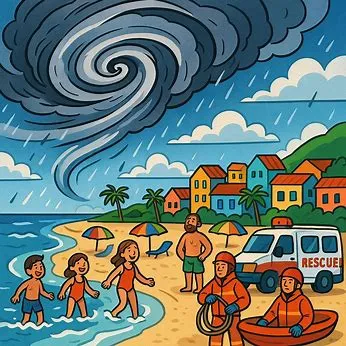
Get ready to be swept away by the wild world of Hurricane Trivia Questions!
Hurricanes are among nature’s most powerful and awe-inspiring phenomena—massive storms born over warm tropical waters, capable of unleashing winds stronger than a speeding train and rain that can flood entire cities.
But beyond the chaos lies a fascinating blend of science, history, and surprising facts.
Hurricane Trivia Questions and Answers
1. Question: What is the term used for the center of a hurricane?
Answer: Eye
2. Question: Hurricanes form over which type of water?
Answer: Warm tropical oceans
3. Question: What scale is used to classify the intensity of hurricanes?
Answer: Saffir-Simpson Hurricane Wind Scale
4. Question: What is the minimum sustained wind speed for a storm to be classified as a hurricane?
Answer: 74 mph (119 km/h)
5. Question: Hurricanes are also known by what other name in the western Pacific Ocean?
Answer: Typhoons
6. Question: Which U.S. state is most frequently hit by hurricanes?
Answer: Florida
7. Question: What is the term for the calm area in the center of a hurricane?
Answer: The Eye
8. Question: What is the opposite of a hurricane in terms of rotation in the Northern Hemisphere?
Answer: Counterclockwise rotation (hurricanes rotate counterclockwise in the Northern Hemisphere)
9. Question: What phenomenon can cause the storm surge during a hurricane?
Answer: High winds pushing seawater toward the coast
10. Question: What was the deadliest hurricane in U.S. history?
Answer: The Galveston Hurricane of 1900
11. Question: Hurricanes are categorized from 1 to 5 based on which factor?
Answer: Wind speed
12. Question: What is the name of the hurricane tracking and forecasting organization in the U.S.?
Answer: National Hurricane Center (NHC)
13. Question: What is the main difference between a hurricane and a tropical storm?
Answer: Wind speed (tropical storms have winds less than 74 mph)
14. Question: Which hurricane in 2005 is known as the costliest in U.S. history?
Answer: Hurricane Katrina
15. Question: Hurricanes rotate clockwise or counterclockwise in the Southern Hemisphere?
Answer: Clockwise
16. Question: What is the term for the area surrounding the eye that has the most severe weather?
Answer: The Eye Wall
17. Question: How are hurricanes named?
Answer: Using a pre-determined alphabetical list of male and female names
18. Question: What is the minimum category for a hurricane to be considered “major”?
Answer: Category 3
19. Question: Hurricanes can produce tornadoes. True or False?
Answer: True
20. Question: What is the term for the weakening of a hurricane when it moves over land?
Answer: Landfall
Also Check: 184+ Caribbean Trivia Questions and Answers
Funny Hurricane Trivia Questions and Answers
1. Question: What part of a hurricane is so calm it’s basically a weather spa?
Answer: The Eye
2. Question: Why did the hurricane go to school?
Answer: To improve its “current” events knowledge.
3. Question: What do you call a hurricane that takes a nap?
Answer: A snoozicane
4. Question: Why don’t hurricanes ever get lost?
Answer: Because they always follow the wind.
5. Question: What’s a hurricane’s favorite type of music?
Answer: Heavy metal (all that wind and rain!)
6. Question: Why did the hurricane break up with the tornado?
Answer: It needed some space.
7. Question: What’s a hurricane’s favorite game to play on land?
Answer: Twister
8. Question: What did the hurricane say to the town before leaving?
Answer: “I’ll be back… in another season!”
9. Question: Why was the hurricane so good at math?
Answer: Because it always multiplies destruction.
10. Question: What snack do hurricanes hate?
Answer: Popcorn—too hard to handle the popping wind.
11. Question: How do hurricanes stay in shape?
Answer: Lots of wind sprints and water aerobics.
12. Question: What do hurricanes use to freshen their breath?
Answer: Cyclone mints
13. Question: Why did the hurricane go to therapy?
Answer: It had too many unresolved gusts.
14. Question: What is a hurricane’s favorite dance move?
Answer: The spin cycle
15. Question: What do you get if a hurricane tells jokes?
Answer: A pun-demic storm
16. Question: Why did the hurricane apply for a job?
Answer: It wanted to make a “storming” career.
17. Question: What’s the favorite instrument of a hurricane?
Answer: The wind chimes
18. Question: Why do hurricanes love vacations?
Answer: They get to go somewhere tropical!
19. Question: How does a hurricane check its social life?
Answer: It scrolls through the “current” events.
20. Question: Why did the hurricane carry an umbrella?
Answer: Just in case it wanted to be extra dramatic.
Also Check: 145+ Spring Season Trivia Questions and Answers
Hurricane Trivia Questions and Answers for Adults
1. Question: What is the scientific term for the calm, circular center of a hurricane?
Answer: The eye
2. Question: On what scale are hurricanes in the Atlantic and Northeast Pacific basins ranked, based on their sustained wind speeds?
Answer: The Saffir-Simpson Hurricane Wind Scale
3. Question: What does a hurricane’s “category” refer to?
Answer: Its wind speed. Categories range from 1 (74–95 mph) to 5 (157 mph or higher)
4. Question: How many categories are on the Saffir-Simpson Hurricane Wind Scale?
Answer: Five
5. Question: What are hurricanes called in the Northwest Pacific Ocean?
Answer: Typhoons
6. Question: In the Southern Hemisphere (Indian Ocean and South Pacific), what are hurricanes called?
Answer: Tropical cyclones
7. Question: What is the minimum sustained wind speed required for a tropical storm to be classified as a hurricane?
Answer: 74 mph
8. Question: What is the name of the organization that is responsible for naming hurricanes in the Atlantic basin?
Answer: The World Meteorological Organization (WMO)
9. Question: Why are some hurricane names, like Katrina or Sandy, retired and never used again?
Answer: Because the storms were so deadly or caused so much destruction that reusing their names would be insensitive
10. Question: What is a “storm surge”?
Answer: The abnormal rise in sea level accompanying a hurricane or other intense storm, which can cause immense coastal flooding
11. Question: What year did the most active Atlantic hurricane season on record occur, with 28 named storms?
Answer: 2005
12. Question: What was the name of the most powerful hurricane to ever hit the United States mainland, based on its wind speed at landfall?
Answer: Hurricane Camille (1969)
13. Question: What hurricane was the most financially costly in U.S. history?
Answer: Hurricane Katrina (2005)
14. Question: What was the name of the 2012 hurricane that caused widespread damage along the Eastern Seaboard and was known for its massive size and inland flooding?
Answer: Hurricane Sandy
15. Question: What is the name of the first hurricane ever to be classified as a Category 5 in the Atlantic Ocean?
Answer: The Labor Day Hurricane of 1935
16. Question: Which country is most affected by hurricanes, on average?
Answer: The United States
17. Question: What is the name of the hurricane that caused the most deaths in U.S. history?
Answer: The Great Galveston Hurricane of 1900
18. Question: What is the official start and end date of the Atlantic hurricane season?
Answer: June 1st to November 30th
19. Question: In what month do most major hurricanes (Category 3 or higher) typically form in the Atlantic?
Answer: September
20. Question: What is the name of the satellite that provides constant monitoring of tropical storms and hurricanes from space?
Answer: GOES (Geostationary Operational Environmental Satellite)
Hard Hurricane Trivia Questions and Answers
1. Question: What hurricane is known as the deadliest weather disaster in United States history?
Answer: The Great Galveston Hurricane of 1900
2. Question: Which hurricane set the record for the most intense hurricane to make landfall in the U.S.?
Answer: Labor Day Hurricane of 1935
3. Question: In what year did Hurricane Katrina devastate the Gulf Coast, causing approximately 1,200 deaths?
Answer: 2005
4. Question: Which hurricane caused a 16-foot storm surge and killed around 2,000 people in Louisiana in 1893?
Answer: Chenière Caminada hurricane
5. Question: What hurricane caused nearly 15-foot storm surges in Coconut Grove, Florida, and devastated Miami in 1926?
Answer: The Great Miami Hurricane
6. Question: Which hurricane killed at least 2,500 people due to flooding around Lake Okeechobee in 1928?
Answer: The 1928 Okeechobee hurricane
7. Question: Which hurricane was the first-ever Category 5 hurricane to strike the U.S. mainland in September 1935?
Answer: The Great Labor Day hurricane
8. Question: Which hurricane led to flooding and levee failures that inundated much of New Orleans?
Answer: Hurricane Katrina
9. Question: Which hurricane was responsible for 344 fatalities at sea during World War II due to its devastating storm?
Answer: The Great Atlantic Hurricane (1944)
10. Question: How many people were killed by the Sea Islands hurricane of 1893?
Answer: Approximately 2,000
11. Question: What was the maximum wind speed reported during the Great Miami hurricane of 1926?
Answer: Nearly 150 mph
12. Question: How many ships were lost during the Great Atlantic Hurricane in 1944?
Answer: Ten ships
13. Question: Which hurricane caused the costliest damage in U.S. history as of 2025, with an estimated $161 billion in damage?
Answer: Hurricane Katrina
14. Question: Which hurricane in 1957 caused an 8- to 12-foot storm surge penetrating southwestern Louisiana?
Answer: Hurricane Audrey
15. Question: What was the estimated number of deaths due to storm tides during the 1900 Galveston Hurricane?
Answer: At least 8,000
16. Question: Which hurricane in 1881 killed at least 700 people in the Georgia/South Carolina region?
Answer: The Georgia/South Carolina hurricane (unnamed)
17. Question: The 1928 Okeechobee hurricane caused how many deaths in Florida alone due to the lake surge?
Answer: 1,836
18. Question: What category was the Great Galveston hurricane when it hit Texas?
Answer: Category 4
19. Question: When did the hurricane known as Hurricane Audrey strike the Gulf Coast?
Answer: June 1957
20. Question: Which hurricane had a barometric pressure drop to 27.61 inches as it passed over Miami?
Answer: Great Miami Hurricane of 1926
Easy Hurricane Trivia Questions and Answers
1. Question: What is the name given to a tropical cyclone with sustained winds of at least 74 mph in the Atlantic Ocean?
Answer: Hurricane
2. Question: In which season do hurricanes most commonly occur in the Atlantic?
Answer: Hurricane season (June 1 to November 30)
3. Question: What is the calm center of a hurricane called?
Answer: The eye
4. Question: Which U.S. state is most frequently hit by hurricanes?
Answer: Florida
5. Question: What scale is used to measure the intensity of hurricanes, ranging from Category 1 to 5?
Answer: Saffir-Simpson Scale
6. Question: What is the name of the deadliest U.S. hurricane, which struck Galveston, Texas, in 1900?
Answer: The Galveston Hurricane
7. Question: In which ocean do hurricanes form near the United States?
Answer: Atlantic Ocean
8. Question: What is the term for the heavy rain and strong winds that spiral around a hurricane’s eye?
Answer: The eyewall
9. Question: Which government agency in the U.S. is responsible for tracking and forecasting hurricanes?
Answer: National Hurricane Center (NHC)
10. Question: What is the name of a hurricane-like storm in the western Pacific Ocean?
Answer: Typhoon
11. Question: Which direction do hurricanes typically spin in the Northern Hemisphere?
Answer: Counterclockwise
12. Question: What type of weather event often accompanies hurricanes, causing dangerous flooding?
Answer: Storm surge
13. Question: What is the minimum wind speed for a tropical storm to become a hurricane?
Answer: 74 mph
14. Question: Which hurricane devastated New Orleans in 2005, causing widespread flooding?
Answer: Hurricane Katrina
15. Question: What is the name of the warm ocean waters needed for hurricanes to form?
Answer: Tropical waters (at least 80°F or 26.5°C)
16. Question: Which month is typically the peak of the Atlantic hurricane season?
Answer: September
17. Question: What is the name of the first hurricane to make landfall in the U.S. in 2024?
Answer: Hurricane Beryl
18. Question: What gas in the atmosphere helps fuel hurricanes by providing energy through condensation?
Answer: Water vapor
19. Question: Which U.S. city was heavily impacted by Hurricane Andrew in 1992?
Answer: Miami, Florida
20. Question: What is the term for when a hurricane weakens to below 74 mph and is no longer classified as a hurricane?
Answer: Tropical storm
Hurricane Quizzes
1. Question: What is the scientific term for the calm, low-pressure center of a hurricane?
Answer: The eye
2. Question: What is the minimum sustained wind speed for a storm to be classified as a hurricane?
Answer: 74 mph
3. Question: What is the name for a hurricane that forms in the Northwest Pacific Ocean?
Answer: A typhoon
4. Question: In the Southern Hemisphere, which way do hurricanes (tropical cyclones) rotate?
Answer: Clockwise. In the Northern Hemisphere, they rotate counter-clockwise
5. Question: What is a storm’s “eyewall”?
Answer: The ring of thunderstorms and the most intense winds and rainfall that surround the calm eye
6. Question: What is the name of the scale used to classify hurricanes based on their sustained wind speeds?
Answer: The Saffir-Simpson Hurricane Wind Scale
7. Question: What is a “storm surge”?
Answer: The abnormal rise in sea level caused by a hurricane’s winds pushing water toward the shore, which can cause severe coastal flooding
8. Question: What is the official start and end date of the Atlantic hurricane season?
Answer: June 1st to November 30th
9. Question: What’s the difference between a “hurricane watch” and a “hurricane warning”?
Answer: A watch means hurricane conditions are possible within 48 hours. A warning means they are expected within 36 hours
10. Question: What is the primary energy source that fuels a hurricane?
Answer: Warm, moist air rising from the ocean’s surface
11. Question: Who is responsible for the rotating lists of names used for hurricanes in the Atlantic and Eastern Pacific basins?
Answer: The World Meteorological Organization (WMO)
12. Question: Why are some hurricane names, like “Katrina” and “Sandy,” retired and never used again?
Answer: The names are retired to honor the victims of storms that were exceptionally deadly or destructive
13. Question: What was the first hurricane on record to be classified as a Category 5 in the Atlantic Ocean?
Answer: The “Labor Day Hurricane” of 1935
14. Question: What year had the most active Atlantic hurricane season on record, with 28 named storms?
Answer: 2005
15. Question: What was the name of the hurricane that was the most financially costly in U.S. history?
Answer: Hurricane Katrina
16. Question: What year saw the “Great Galveston Hurricane,” the deadliest natural disaster in U.S. history?
Answer: 1900
17. Question: Which category on the Saffir-Simpson scale is considered a “major hurricane”?
Answer: Categories 3, 4, and 5
18. Question: How fast must the wind be for a storm to be considered a Category 5 hurricane?
Answer: 157 mph or higher
19. Question: What is the name of the hurricane that devastated Puerto Rico in 2017 and was considered the deadliest on the island in over a century?
Answer: Hurricane Maria
20. Question: What is the name of the large-scale weather phenomenon in the Pacific Ocean that often leads to more active Atlantic hurricane seasons?
Answer: La Niña
Best Hurricane Trivia Questions and Answers
1. Question: What is the scientific term for the calm center of a hurricane?
Answer: The eye
2. Question: What minimum wind speed defines a hurricane?
Answer: 74 mph
3. Question: Hurricanes in the Northwest Pacific Ocean are called what?
Answer: Typhoons
4. Question: In which hemisphere do hurricanes rotate clockwise?
Answer: Southern Hemisphere
5. Question: What is the “eyewall” of a hurricane?
Answer: The ring of thunderstorms and the most intense winds surrounding the eye
6. Question: Which scale measures hurricane intensity from Category 1 to 5?
Answer: Saffir-Simpson Hurricane Wind Scale
7. Question: What is a storm surge?
Answer: The abnormal rise in sea level caused by a hurricane’s winds
8. Question: What are the official start and end dates of the Atlantic hurricane season?
Answer: June 1 to November 30
9. Question: What is the difference between a hurricane watch and a hurricane warning?
Answer: Watch = conditions possible in 48 hours; Warning = conditions expected in 36 hours
10. Question: What is the primary energy source that fuels hurricanes?
Answer: Warm, moist air from the ocean’s surface
11. Question: Which organization names hurricanes in the Atlantic?
Answer: World Meteorological Organization (WMO)
12. Question: Why are some hurricane names retired?
Answer: Because the storms were exceptionally deadly or destructive
13. Question: What was the first Category 5 hurricane in the Atlantic on record?
Answer: Labor Day Hurricane of 1935
14. Question: Which hurricane season holds the record for most named storms?
Answer: 2005 (28 named storms)
15. Question: Which hurricane caused the costliest damage in U.S. history?
Answer: Hurricane Katrina
16. Question: What year did the Great Galveston Hurricane strike, the deadliest in U.S. history?
Answer: 1900
17. Question: What categories are considered “major hurricanes”?
Answer: Categories 3, 4, and 5
18. Question: What wind speed defines a Category 5 hurricane?
Answer: 157 mph or higher
19. Question: Which hurricane devastated Puerto Rico in 2017?
Answer: Hurricane Maria
20. Question: What Pacific Ocean phenomenon often leads to more active Atlantic hurricane seasons?
Answer: La Niña
Conclusion
From swirling superstorms to the science behind the surge, hurricane trivia offers a thrilling dive into one of nature’s most dramatic forces.
Whether you mastered the facts or learned something new, you’ve just explored the fascinating layers of meteorology, history, and global impact that hurricanes carry with them.
So the next time you hear names like Katrina, Harvey, or Irma, you’ll know there’s more than just wind and rain behind them—there’s a story, a science, and a legacy.