
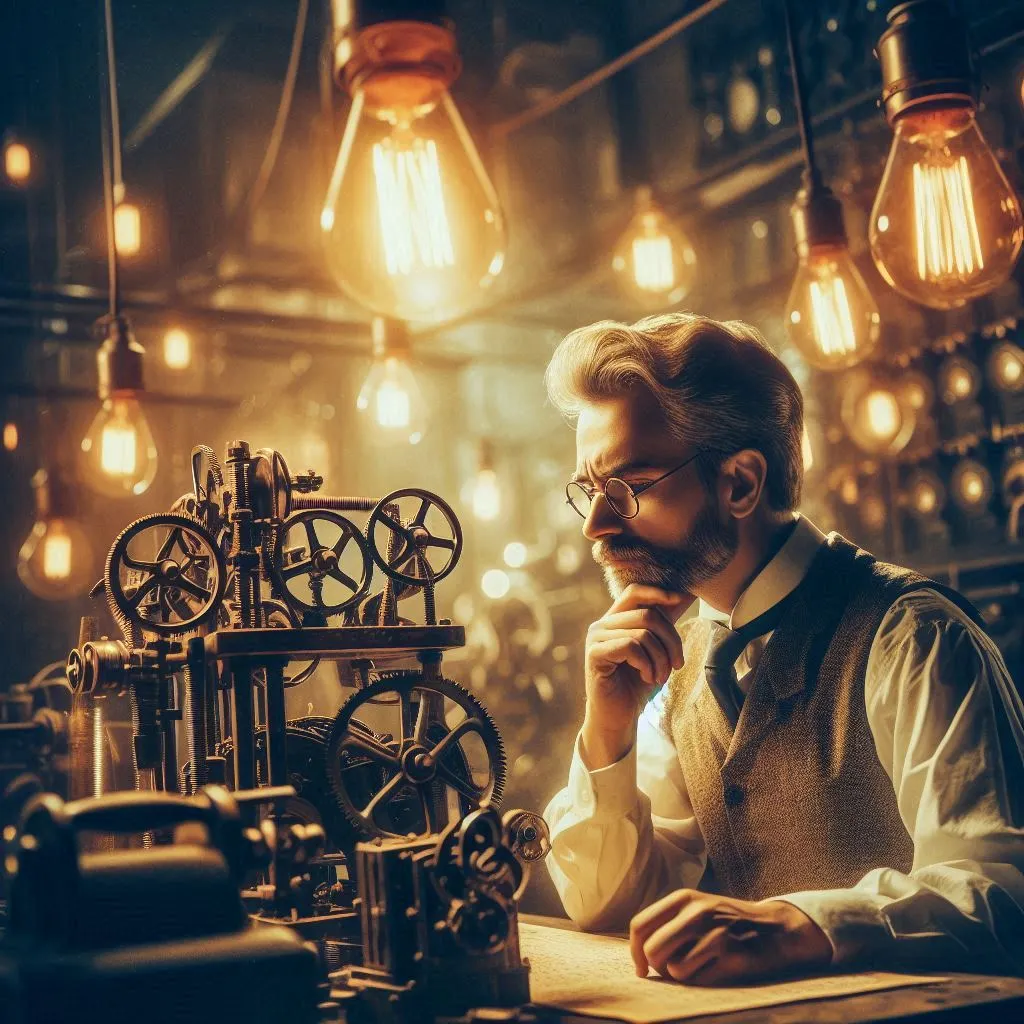
Step into the fascinating world of Thomas Edison Trivia Questions and Answers and discover interesting facts about one of history’s most famous inventors. Thomas Edison is remembered for his groundbreaking work, famous inventions, scientific experiments, and remarkable contribution to modern technology. But how much do you really know about his life, inventions, achievements, and the stories behind his success?
In this collection of Thomas Edison Trivia Questions and Answers (2026), you’ll find a wide variety of entertaining and informative questions covering Edison’s early life, inventions, career, experiments, famous quotes, business ventures, and lesser-known facts.
Whether you’re a history enthusiast, a student, a teacher, or simply looking for an engaging trivia challenge, these questions are a great way to explore the remarkable life of Thomas Edison.
Get ready to test yourself, discover surprising facts, and see how many questions you can answer correctly!
Easy Thomas Edison Trivia Questions and Answers
1. Who was Thomas Edison?
Answer: Thomas Edison was an American inventor and businessman.
Explanation: He became famous for developing and improving technologies in electricity, sound recording, motion pictures, and communications.
Key Information: Edison held more than 1,000 U.S. patents during his lifetime.
2. When was Thomas Edison born?
Answer: February 11, 1847.
Explanation: Edison was born in Milan, Ohio, United States.
Key Information: His full name was Thomas Alva Edison.
3. Where was Thomas Edison born?
Answer: Milan, Ohio.
Explanation: Edison was born in this small Ohio community before his family later moved to Michigan.
Key Information: He spent much of his childhood in Port Huron, Michigan.
4. What was Thomas Edison’s middle name?
Answer: Alva.
Explanation: His full name was Thomas Alva Edison.
Key Information: He was commonly known simply as Thomas Edison.
5. How did Thomas Edison receive most of his early education?
Answer: Through homeschooling and self-directed learning.
Explanation: Edison attended school only briefly and was largely educated by his mother after she decided to teach him at home.
Key Information: He developed a strong interest in science, reading, and experimentation at a young age.
6. What did Thomas Edison famously say about his schooling?
Answer: He was highly critical of traditional schooling and valued independent learning.
Explanation: His mother played a major role in encouraging his curiosity and teaching him at home.
Key Information: Edison became a strong advocate for learning through reading and experimentation.
7. What was one of Edison’s first jobs?
Answer: He worked as a telegraph operator.
Explanation: His work with telegraph equipment gave him valuable experience with electricity and communication technology.
Key Information: Telegraphy strongly influenced his early inventive career.
8. What invention made Edison famous as a young inventor?
Answer: Improvements to the stock ticker and other telegraph-related devices helped establish his reputation.
Explanation: Edison developed practical improvements to communication equipment before becoming famous for later inventions.
Key Information: His early work demonstrated his focus on improving existing technology.
9. What was the phonograph?
Answer: A device capable of recording and reproducing sound.
Explanation: Edison developed the phonograph in 1877, making it one of the first machines able to record and play back human speech and other sounds.
Key Information: The phonograph brought Edison international fame.
10. What did Thomas Edison invent in 1877?
Answer: The phonograph.
Explanation: Edison and his team developed a machine that could record sound onto a medium and reproduce it.
Key Information: The phonograph was one of Edison’s most important early inventions.
11. What was the famous first recorded phrase associated with Edison’s phonograph?
Answer: “Mary had a little lamb.”
Explanation: Edison demonstrated that his phonograph could record and reproduce spoken words, using the familiar nursery rhyme in an early demonstration.
Key Information: The recording became one of the most famous demonstrations in the history of sound recording.
12. Did Thomas Edison invent the first practical electric light bulb?
Answer: He developed a commercially practical incandescent electric lighting system, but he did not invent the concept of the electric light bulb from scratch.
Explanation: Other inventors had created earlier electric lamps, while Edison improved the lamp and developed supporting systems for practical widespread use.
Key Information: His major achievement was creating a workable electric lighting system that could be commercially deployed.
13. What was important about Edison’s electric lighting system?
Answer: It combined practical light bulbs with generators, wiring, switches, and distribution systems.
Explanation: Edison understood that widespread electric lighting required an entire system rather than simply a bulb.
Key Information: This systems approach helped make electric lighting commercially useful.
14. Where did Edison establish his famous research laboratory?
Answer: Menlo Park, New Jersey.
Explanation: Edison established a major research and development laboratory there in the late 1870s.
Key Information: Menlo Park became famous as an early example of an organized industrial research laboratory.
15. What was Menlo Park known for?
Answer: Intensive research, experimentation, and invention.
Explanation: Edison and his team worked on numerous electrical, mechanical, and communication technologies there.
Key Information: Edison became known as the “Wizard of Menlo Park.”
16. What was Thomas Edison’s nickname?
Answer: The Wizard of Menlo Park.
Explanation: The nickname reflected his extraordinary reputation as an inventor and his famous laboratory in Menlo Park.
Key Information: Newspapers and the public helped popularize the nickname.
17. What contribution did Edison make to motion pictures?
Answer: He and his laboratory developed important early motion-picture technologies.
Explanation: Edison’s team worked on devices for recording and viewing moving images, including the Kinetograph and Kinetoscope.
Key Information: Motion-picture development involved many inventors, not Edison alone.
18. What was the Kinetoscope?
Answer: An early motion-picture viewing machine.
Explanation: It allowed a person to watch moving images through a viewing window.
Key Information: The Kinetoscope helped introduce motion pictures to the public before modern movie projection became widespread.
19. What was the Kinetograph?
Answer: An early motion-picture camera developed by Edison’s laboratory.
Explanation: It was designed to capture sequences of photographic images that could be viewed as motion.
Key Information: Edison’s motion-picture work contributed to the early development of cinema technology.
20. When did Thomas Edison die?
Answer: October 18, 1931.
Explanation: Edison died at his home in West Orange, New Jersey, at the age of 84.
Key Information: He left behind a major legacy in electrical technology, sound recording, motion pictures, and industrial research.
Recommended: 143+ Workplace Trivia Questions and Answers
Funny Thomas Edison Trivia Questions and Answers
1. What was Thomas Edison’s father’s name?
Answer: Samuel Ogden Edison Jr.
Explanation: Edison’s father was born in Canada and later lived in Ohio and Michigan.
Key Information: Edison was the youngest of seven children.
2. What was Thomas Edison’s mother’s name?
Answer: Nancy Matthews Elliott Edison.
Explanation: His mother was a former schoolteacher who played a major role in his early education.
Key Information: Edison credited his mother with encouraging his curiosity and confidence.
3. Where did Edison spend much of his childhood?
Answer: Port Huron, Michigan.
Explanation: His family moved there from Milan, Ohio, when Edison was still young.
Key Information: Port Huron became an important place in his early life and education.
4. What subject fascinated Edison as a child?
Answer: Science and experimentation.
Explanation: He enjoyed reading about scientific ideas and conducting experiments on his own.
Key Information: His curiosity eventually developed into a lifelong career in invention.
5. Why did Edison’s mother teach him at home?
Answer: She believed he could learn better outside the traditional classroom system.
Explanation: After he had a short and difficult experience at school, his mother took responsibility for his education.
Key Information: She encouraged him to read widely and pursue subjects that interested him.
6. What physical challenge affected Edison during his later childhood?
Answer: Significant hearing loss.
Explanation: Edison became increasingly hard of hearing during his youth and adulthood.
Key Information: Despite his hearing difficulties, he continued working extensively with sound-related technology.
7. How did Edison first become interested in telegraphy?
Answer: Through his work as a telegraph operator.
Explanation: Telegraphy exposed him to electrical circuits, signals, batteries, and communication systems.
Key Information: His telegraph experience became an important foundation for his inventive career.
8. What was Edison’s first patented invention?
Answer: An improved electric vote recorder.
Explanation: Edison patented the device in 1869, but legislators did not find it commercially useful.
Key Information: The experience taught Edison an important lesson about inventing products that people actually wanted.
9. Why did Edison become more interested in commercially useful inventions?
Answer: His early vote recorder taught him that technical success did not automatically guarantee public demand.
Explanation: He later focused heavily on inventions that solved practical problems and had commercial potential.
Key Information: This approach became a defining part of his career.
10. What invention helped Edison gain financial success before the phonograph?
Answer: Improvements to the stock ticker.
Explanation: Edison improved telegraph-based stock quotation equipment and earned money from related inventions.
Key Information: His financial success helped him establish larger laboratories and pursue further research.
11. What was Edison’s approach to invention?
Answer: He emphasized repeated experimentation and practical testing.
Explanation: Edison often tried many materials and designs before finding a workable solution.
Key Information: His Menlo Park laboratory helped turn experimentation into an organized team process.
12. Why is Edison associated with the phrase about finding many ways that did not work?
Answer: He became famous for emphasizing persistence during experimentation.
Explanation: Edison often described failed experiments as useful information rather than simply wasted effort.
Key Information: Persistence became a major part of his public image as an inventor.
13. What was the purpose of Edison’s Menlo Park laboratory?
Answer: To conduct organized research and develop practical inventions.
Explanation: Edison brought together skilled workers, machinists, scientists, and other specialists to work on projects.
Key Information: Menlo Park helped establish the model of the industrial research laboratory.
14. What was Edison’s later laboratory complex in New Jersey?
Answer: The laboratory in West Orange, New Jersey.
Explanation: Edison established a much larger research facility there after his Menlo Park period.
Key Information: West Orange became one of the main centers of his later experimental work.
15. What did Edison work on besides electric lighting?
Answer: Sound recording, motion pictures, batteries, telegraphy, mining technology, and many other technologies.
Explanation: His career covered a remarkably wide range of technical fields.
Key Information: Edison was not limited to a single invention or scientific area.
16. What was the Edison storage battery?
Answer: A rechargeable battery developed by Edison using nickel and iron chemistry.
Explanation: Edison worked for years to develop a durable rechargeable battery.
Key Information: The nickel-iron battery became known for its robustness and long service life.
17. Why did Edison work on batteries?
Answer: He believed improved rechargeable batteries could have useful applications in transportation and industry.
Explanation: He explored batteries for electric vehicles, mining equipment, and other uses.
Key Information: His battery research continued for many years.
18. What role did Edison play in the development of electrical power systems?
Answer: He developed and promoted practical systems for generating and distributing electric power.
Explanation: His work included generators, wiring, meters, switches, and electric lighting systems.
Key Information: His Pearl Street Station in New York became an important early commercial power station.
19. What was Pearl Street Station?
Answer: One of the world’s first central electric power stations.
Explanation: It began supplying electricity to customers in lower Manhattan in 1882.
Key Information: The station demonstrated the practical operation of a centralized electrical distribution system.
20. Why is Thomas Edison still historically important?
Answer: He helped transform several experimental technologies into practical commercial systems.
Explanation: His work influenced electric power, lighting, sound recording, motion pictures, communications, and industrial research.
Key Information: His legacy includes both individual inventions and the broader research-and-development methods he helped popularize.
Related: 136+ Electrifying AC DC Trivia Questions And Answers
Best Thomas Edison Trivia Questions and Answers
1. What was Thomas Edison’s first patented invention?
Answer: An electric vote recorder.
Explanation: Edison patented the device in 1869, intending to make voting faster in legislative settings.
Key Information: The invention was technically successful but had little commercial demand.
2. In which year did Edison receive his first patent?
Answer: 1869.
Explanation: His first patent was granted for the electric vote recorder.
Key Information: This marked the beginning of a remarkable patent career.
3. What was the purpose of Edison’s electric vote recorder?
Answer: To record votes electronically.
Explanation: It was designed to allow legislators to register “yes” or “no” votes quickly.
Key Information: Edison later became more interested in inventions with clear commercial demand.
4. What did Edison improve about the stock ticker?
Answer: He improved its ability to transmit and display stock-price information.
Explanation: His work made the device more reliable and useful for financial businesses.
Key Information: The invention helped establish Edison as a practical inventor.
5. What was the Universal Stock Ticker?
Answer: A stock quotation machine associated with Edison’s improvements.
Explanation: It displayed financial information transmitted through telegraph lines.
Key Information: Edison earned significant recognition and income from his telegraph-related work.
6. What was the quadruplex telegraph?
Answer: A telegraph system capable of transmitting multiple signals over one wire.
Explanation: Edison developed important improvements to telegraph technology, including work related to multiple-message transmission.
Key Information: Such innovations increased the capacity and efficiency of telegraph networks.
7. Why was telegraph technology important to Edison?
Answer: It provided his early professional experience with electrical communication.
Explanation: Working with telegraphs taught him about circuits, batteries, signals, and electrical equipment.
Key Information: Many of his early inventions grew out of his telegraph experience.
8. What was Edison’s first major laboratory at Menlo Park designed to do?
Answer: Develop inventions through organized experimentation.
Explanation: Edison brought different specialists together so that experiments, machining, testing, and development could happen in one place.
Key Information: This approach became an important model for industrial research.
9. Who worked with Edison at his laboratories?
Answer: Engineers, machinists, laboratory assistants, chemists, and other skilled workers.
Explanation: Many of Edison’s achievements depended on teamwork rather than one person working alone.
Key Information: Edison’s laboratories were among the earliest major examples of organized industrial R&D.
10. What material did Edison famously test for incandescent lamp filaments?
Answer: Carbon-based materials, including carbonized plant fibers.
Explanation: Edison and his team tested many materials while searching for a durable filament.
Key Information: Their work eventually produced commercially useful incandescent lamps.
11. Why was Edison’s light bulb important?
Answer: It was part of a practical electric lighting system.
Explanation: Edison worked not only on the lamp but also on generators, wiring, switches, meters, and distribution.
Key Information: The complete system helped make electric lighting commercially practical.
12. What was the Pearl Street electrical station?
Answer: An early central power station developed as part of Edison’s electrical system.
Explanation: It supplied electricity to customers in lower Manhattan beginning in 1882.
Key Information: It demonstrated the feasibility of centralized electric power distribution.
13. What type of current did Edison’s early power system use?
Answer: Direct current, or DC.
Explanation: Edison’s early electrical distribution systems were designed around direct-current technology.
Key Information: DC systems later competed with alternating-current systems during the famous “War of the Currents.”
14. Who was George Westinghouse?
Answer: An American inventor and industrialist who promoted alternating-current electrical systems.
Explanation: Westinghouse’s company became a major competitor to Edison’s direct-current approach.
Key Information: The competition between the two systems became known as the “War of the Currents.”
15. What was the “War of the Currents”?
Answer: A late-19th-century competition between direct-current and alternating-current electrical systems.
Explanation: Edison promoted DC while Westinghouse and others supported AC technology.
Key Information: AC ultimately became dominant for large-scale electrical transmission.
16. What was Edison’s role in sound recording?
Answer: He developed the phonograph, one of the first practical machines for recording and reproducing sound.
Explanation: The phonograph could capture sound vibrations and reproduce them.
Key Information: The invention helped launch the modern recorded-sound industry.
17. What was the Edison talking doll?
Answer: An early talking toy that used miniature phonograph technology.
Explanation: Edison attempted to combine recorded sound with a children’s doll.
Key Information: The product was difficult to operate and was not a major commercial success.
18. What was the Black Maria?
Answer: An early motion-picture studio associated with Edison’s laboratory.
Explanation: Built at West Orange, New Jersey, it was used to produce short motion-picture films.
Key Information: It is often regarded as one of the earliest purpose-built film studios.
19. Why did the Black Maria have a movable structure?
Answer: To help position the studio for sunlight.
Explanation: Early film production depended heavily on strong natural light.
Key Information: The building’s design reflected the technical limitations of early filmmaking.
20. What is one major lesson from Edison’s career?
Answer: Successful invention often requires experimentation, persistence, teamwork, and practical development.
Explanation: Edison repeatedly tested ideas, learned from unsuccessful experiments, and worked with teams to turn concepts into usable technologies.
Key Information: His legacy is important not only for individual inventions but also for the development of organized industrial research.
Thomas Edison Trivia Questions and Answers for Adults
1. What was Thomas Edison’s first job as a professional telegraph operator?
Answer: He worked as a telegraph operator in Ontario, Canada.
Explanation: Edison learned telegraphy while still young and later found work operating telegraph equipment.
Key Information: This experience gave him practical knowledge of electrical communication.
2. Who taught Edison how to become a telegraph operator?
Answer: Edison learned important telegraph skills with help from experienced telegraph operators, including J. MacKenzie.
Explanation: His interest in telegraphy grew after he helped rescue a station agent’s child from a railway accident.
Key Information: The station agent rewarded Edison by teaching him telegraphy.
3. What was Edison’s first telegraph-related invention?
Answer: An improved telegraphic vote recorder.
Explanation: Edison designed a machine that could electrically record votes in a legislative setting.
Key Information: It became his first patented invention in 1869.
4. Why did Edison’s electric vote recorder fail commercially?
Answer: Legislators did not want voting to become too quick.
Explanation: Political groups sometimes wanted time to persuade members before a vote was finalized.
Key Information: Edison learned that an invention needed a strong market demand, not just technical usefulness.
5. What lesson did Edison learn from his vote recorder?
Answer: Inventors should create products that people actually want to use.
Explanation: Although his machine worked, customers had little interest in it.
Key Information: This experience influenced Edison’s later commercial approach to invention.
6. What city became an important center of Edison’s early telegraph career?
Answer: Boston.
Explanation: Edison worked there as a telegraph operator and continued experimenting with electrical technology.
Key Information: His time in Boston helped him develop professional connections and technical skills.
7. What did Edison do with much of his telegraph equipment?
Answer: He modified it and experimented with improvements.
Explanation: Edison was interested in making existing communication equipment faster and more efficient.
Key Information: Many of his early inventions were improvements to technologies that already existed.
8. What was Edison’s role in improving the telegraph?
Answer: He developed numerous improvements to telegraph instruments and systems.
Explanation: His work included automatic transmission, printing telegraphs, and multiple-message systems.
Key Information: Telegraph technology provided the foundation for much of his early inventive career.
9. What was the printing telegraph?
Answer: A telegraph system that could automatically print received messages.
Explanation: Instead of requiring an operator to interpret every signal manually, the system produced readable text.
Key Information: Printing telegraphs helped make long-distance communication more convenient.
10. What was the Edison electric pen used for?
Answer: Creating stencils for duplicating documents.
Explanation: The pen used a rapidly moving needle to perforate a stencil sheet.
Key Information: The technology became an early step toward modern document-copying machines.
11. What was the purpose of Edison’s mimeograph technology?
Answer: To make multiple copies of written documents.
Explanation: A prepared stencil could be used repeatedly to reproduce text or illustrations.
Key Information: The technology became useful in offices, schools, and businesses.
12. What was Edison’s carbon telephone transmitter designed to improve?
Answer: The strength and clarity of telephone speech.
Explanation: Carbon-based transmitter technology could produce stronger electrical variations from spoken sounds.
Key Information: Edison’s improvements helped advance practical telephone communication.
13. Why was Edison interested in improving the telephone?
Answer: He wanted to make voice communication clearer and more reliable.
Explanation: Early telephone technology had limitations in transmitting speech over distance.
Key Information: Edison’s work complemented developments made by other telephone inventors.
14. What was Edison’s first major invention after moving to New York?
Answer: Improvements to stock quotation equipment.
Explanation: Edison worked on devices that transmitted and displayed financial information.
Key Information: His stock-ticker improvements helped establish his reputation in the business world.
15. What was a stock ticker?
Answer: A machine that displayed changing stock prices transmitted by telegraph.
Explanation: It allowed financial offices to receive market information without relying entirely on handwritten messages.
Key Information: Stock tickers became essential tools in financial markets.
16. Why did Edison become interested in improving office machines?
Answer: He saw opportunities to make communication and information handling faster.
Explanation: His early inventions included devices for printing, copying, recording, and transmitting information.
Key Information: This practical approach was a recurring feature of his inventive career.
17. What was Edison’s laboratory approach to solving problems?
Answer: He relied heavily on repeated testing and experimentation.
Explanation: Edison and his assistants tested materials, designs, and mechanisms until they found workable solutions.
Key Information: His laboratories helped establish systematic experimentation as part of industrial invention.
18. Why did Edison employ skilled assistants?
Answer: To handle specialized technical and experimental tasks.
Explanation: Large inventions often required expertise in chemistry, mechanics, electricity, and manufacturing.
Key Information: Edison’s achievements were frequently the result of coordinated teamwork.
19. What was special about Edison’s invention process?
Answer: He combined laboratory experimentation with commercial development.
Explanation: His teams not only created ideas but also tested, manufactured, and improved products for practical use.
Key Information: This approach helped shape the modern industrial research laboratory.
20. Why is Edison’s early telegraph career important to his later achievements?
Answer: It gave him practical experience with electricity, communication, and mechanical devices.
Explanation: The knowledge he gained from telegraphy influenced many of his later inventions.
Key Information: His telegraph experience was an important foundation for his work in sound recording, electrical systems, and communications.
Read More : 156+ Fun and Fascinating New Jersey State Trivia Questions and Answers
Thomas Edison Trivia Questions and Answers for Kids
1. What was Thomas Edison’s first successful commercial invention?
Answer: The improved stock ticker.
Explanation: Edison developed improvements to stock quotation equipment that made it more useful and reliable for financial businesses.
Key Information: The success helped Edison gain money and recognition as an inventor.
2. What was the Edison Universal Stock Printer?
Answer: An improved machine for printing stock-market information.
Explanation: It used telegraph signals to receive and print financial information.
Key Information: Edison received important recognition for his work on stock quotation technology.
3. Why did Edison move to Menlo Park?
Answer: To establish a dedicated research and invention facility.
Explanation: Edison wanted a place where experiments, machine work, and product development could happen together.
Key Information: Menlo Park became one of the most famous invention laboratories of the 19th century.
4. What made Edison’s Menlo Park laboratory unusual?
Answer: It operated as a coordinated research and development facility.
Explanation: Scientists, machinists, assistants, and other specialists worked together on invention projects.
Key Information: This model influenced later industrial research laboratories.
5. What did Edison call his Menlo Park facility?
Answer: His “invention factory.”
Explanation: The facility was organized to produce and test inventions continuously rather than relying on occasional individual experiments.
Key Information: This approach helped Edison work on multiple projects at the same time.
6. What was the purpose of Edison’s laboratory library?
Answer: To provide technical and scientific information for research.
Explanation: Books, journals, and reference materials helped Edison and his assistants investigate unfamiliar subjects.
Key Information: Reading and research were important parts of Edison’s experimental process.
7. What was Edison’s approach to choosing materials?
Answer: He tested many different materials experimentally.
Explanation: Instead of assuming one material would work, his team compared numerous possibilities.
Key Information: This systematic trial-and-testing approach was especially important in lamp development.
8. What problem did Edison face when developing an incandescent lamp?
Answer: Finding a filament that could glow for a useful length of time without failing quickly.
Explanation: The filament needed to withstand high temperatures while producing useful light.
Key Information: Finding a practical filament was only one part of developing a complete lighting system.
9. Why did Edison use a vacuum inside incandescent lamps?
Answer: To reduce the interaction of the hot filament with oxygen.
Explanation: Oxygen can cause a hot filament to oxidize and burn rapidly.
Key Information: Improved vacuum technology helped incandescent lamps operate for longer periods.
10. What was the purpose of the lamp socket in Edison’s system?
Answer: To hold the lamp securely and connect it to the electrical circuit.
Explanation: A practical lighting system needed standardized ways to connect and replace lamps.
Key Information: Components such as sockets helped make electric lighting convenient for everyday use.
11. Why did Edison develop electrical switches?
Answer: To allow users to control electric circuits.
Explanation: Customers needed a simple way to turn individual lights and electrical devices on and off.
Key Information: Switches became a basic component of modern electrical systems.
12. What was Edison’s role in developing electrical wiring?
Answer: He developed wiring methods suitable for distributing electric power to customers.
Explanation: His system required practical conductors and distribution networks connecting generators with lamps.
Key Information: Electrical wiring was essential to making electric lighting useful beyond the laboratory.
13. What was Edison’s first commercial electric-light demonstration?
Answer: A demonstration of his electric lighting system at Menlo Park.
Explanation: Edison and his team showed that multiple incandescent lamps could operate from a central electrical supply.
Key Information: Demonstrations helped convince investors and the public that electric lighting could become practical.
14. Why did Edison’s electrical system require standardized components?
Answer: To make installation, operation, and replacement easier.
Explanation: A large electrical network could not depend on unique components for every customer.
Key Information: Standardization became an important part of modern electrical engineering.
15. What was Edison’s contribution to electric meters?
Answer: He developed meters for measuring electrical consumption in his power systems.
Explanation: Accurate measurement allowed utilities to determine how much electricity customers used.
Key Information: Metering was essential for operating electricity as a commercial service.
16. Why did Edison experiment with underground electrical cables?
Answer: To distribute electricity through urban areas while reducing exposed wiring.
Explanation: Underground systems could help manage electrical networks in crowded city streets.
Key Information: Urban power distribution required careful attention to safety and infrastructure.
17. What was Edison’s interest in electric street lighting?
Answer: He wanted electric power to illuminate streets and public areas as well as buildings.
Explanation: Expanding electric lighting beyond individual lamps increased the potential usefulness of his power systems.
Key Information: Electric street lighting became an important part of the growth of urban electrical networks.
18. Why did Edison build experimental electrical systems before large-scale commercial networks?
Answer: To test equipment and identify technical problems.
Explanation: Demonstrations and small systems allowed engineers to evaluate generators, wiring, lamps, and controls.
Key Information: Testing helped improve reliability before wider deployment.
19. What was Edison’s relationship with General Electric?
Answer: His electric companies and business interests contributed to the corporate history that eventually led to General Electric.
Explanation: Edison General Electric Company merged with Thomson-Houston Electric Company in 1892 to form General Electric.
Key Information: Edison himself was no longer running the company by the time of that merger.
20. Why is Edison’s business career as important as his inventions?
Answer: He helped demonstrate how invention could be connected with manufacturing, investment, and commercial distribution.
Explanation: Edison worked to turn technical ideas into products and complete systems that could reach consumers.
Key Information: His combination of invention and business helped shape the modern technology industry.
Thomas Edison Trivia Questions and Answers Key
1. What was Thomas Edison’s first laboratory in West Orange called?
Answer: The Edison Laboratory.
Explanation: Edison established a large research complex in West Orange, New Jersey, in 1887.
Key Information: It became the main center of his experimental work for the rest of his career.
2. Why was the West Orange laboratory larger than Menlo Park?
Answer: Edison wanted more space for expanded research and manufacturing activities.
Explanation: His later projects required larger workshops, laboratories, storage areas, and specialized equipment.
Key Information: The complex became a major industrial research facility.
3. What did Edison’s chemical laboratory allow his team to study?
Answer: Materials and chemical processes used in different inventions.
Explanation: Chemistry was important for batteries, recordings, lamps, and many other technologies.
Key Information: Edison employed specialists to investigate materials systematically.
4. What did Edison’s machine shop do?
Answer: It manufactured and modified experimental equipment and parts.
Explanation: Having machinists nearby allowed Edison’s team to quickly build prototypes and test new designs.
Key Information: Rapid prototyping was a major advantage of his laboratory system.
5. What was a prototype?
Answer: An early working model of a device or invention.
Explanation: Prototypes allow inventors to test whether a design works before producing it on a larger scale.
Key Information: Edison’s laboratories produced many experimental prototypes.
6. Why did Edison keep detailed experimental records?
Answer: To document tests, observations, materials, and results.
Explanation: Written records helped his team compare experiments and continue work systematically.
Key Information: Edison left behind a huge collection of laboratory notebooks and documents.
7. How many laboratory notebooks are associated with Edison?
Answer: Thousands of laboratory notebooks and related documents survive.
Explanation: Edison and his assistants recorded an enormous amount of information during decades of experimentation.
Key Information: These records provide historians with detailed evidence about his working methods.
8. What can historians learn from Edison’s laboratory notebooks?
Answer: They can study his experiments, ideas, failures, improvements, and working process.
Explanation: The notebooks reveal how Edison and his teams approached technical problems.
Key Information: They are valuable historical sources for studying invention and industrial research.
9. What was Edison’s approach when an experiment failed?
Answer: He generally treated the result as information that could guide further experiments.
Explanation: Failed tests helped his team eliminate unsuitable materials and designs.
Key Information: Repeated experimentation was central to his method.
10. What did Edison’s assistants contribute to his projects?
Answer: They performed experiments, built equipment, recorded results, and developed technical solutions.
Explanation: Large projects required many people with specialized skills.
Key Information: Edison’s achievements were strongly dependent on collaborative laboratory work.
11. What was Edison’s interest in the electric railway?
Answer: He experimented with electric railway technology and transportation systems.
Explanation: Edison investigated ways electricity could be used to power transportation.
Key Information: Electric transportation was one of many areas he explored beyond lighting.
12. What was Edison’s interest in mining machinery?
Answer: He developed machinery intended to process and separate useful minerals.
Explanation: His experiments included mechanical systems and magnetic equipment for ore processing.
Key Information: His mining projects demonstrated his willingness to enter challenging industrial fields.
13. Why did Edison investigate low-grade iron ore?
Answer: He believed technology could make previously uneconomical ore useful.
Explanation: Magnetic separation offered a possible method for extracting iron from material containing relatively little iron.
Key Information: The project required major investments in machinery and infrastructure.
14. What was one problem with Edison’s iron-ore project?
Answer: The process was not economical enough compared with competing iron sources.
Explanation: Even technically workable processes must compete on cost and efficiency.
Key Information: Edison eventually abandoned large-scale efforts in this area.
15. What was Edison’s connection to concrete construction?
Answer: He promoted molded concrete houses and developed methods for producing them.
Explanation: Edison believed concrete could provide durable structures using a relatively efficient construction process.
Key Information: His concrete-house ideas were innovative but did not become widespread.
16. What was unusual about Edison’s proposed concrete houses?
Answer: An entire house could theoretically be formed using reusable molds.
Explanation: The concept aimed to reduce construction time and labor by pouring concrete into a large mold.
Key Information: Edison envisioned affordable standardized housing using industrial methods.
17. What type of storage battery did Edison promote for electric vehicles?
Answer: His nickel-iron storage battery.
Explanation: Edison believed rechargeable batteries could have useful applications in transportation.
Key Information: The battery was durable but had limitations that prevented it from dominating the automobile market.
18. Why did Edison support electric vehicles?
Answer: He believed rechargeable electric power could provide a practical alternative for transportation.
Explanation: At the beginning of the automobile era, electric, steam, and gasoline vehicles all competed.
Key Information: Edison even worked with automobile pioneer Henry Ford on battery-related ideas.
19. Who was Henry Ford in relation to Thomas Edison?
Answer: Henry Ford was a fellow American industrialist and a personal acquaintance of Edison.
Explanation: Ford greatly admired Edison and had professional and personal connections with him.
Key Information: The two became associated with American innovation and industrial development.
20. What famous event honored Edison and other American innovators in 1929?
Answer: A celebration at Dearborn, Michigan, commemorating the anniversary of Edison’s electric light.
Explanation: Henry Ford organized a major historical celebration connected with Edison’s achievements.
Key Information: The event demonstrated how highly Edison’s contributions were regarded during his lifetime.
FAQS
1. When was Thomas Edison born?
Thomas Edison was born on February 11, 1847.
He was born in Milan, Ohio, United States.
2. What is Thomas Edison famous for?
Thomas Edison is famous for developing practical electric lighting and many other inventions.
He also helped create the modern electric power system.
4. How many patents did Thomas Edison receive?
Thomas Edison received more than 1,000 U.S. patents during his lifetime.
He was one of the most prolific inventors in American history.
7. When did Thomas Edison die?
Thomas Edison died on October 18, 1931.
He was 84 years old at the time of his death.
Final Thoughts
Thomas Edison’s life was filled with curiosity, experimentation, determination, and remarkable achievements. From his famous inventions to his countless experiments, his story continues to capture the imagination of people around the world.
We hope these 165+ Thomas Edison Trivia Questions and Answers gave you a fresh look at the inventor behind some of the most influential developments of his era.
Whether you answered nearly every question correctly or discovered many new facts along the way, there’s always something interesting to learn about Edison. Share this trivia with friends, classmates, or fellow history fans and see who can score the highest!
Recommend:
165+ Famous People Trivia Questions and Answers