
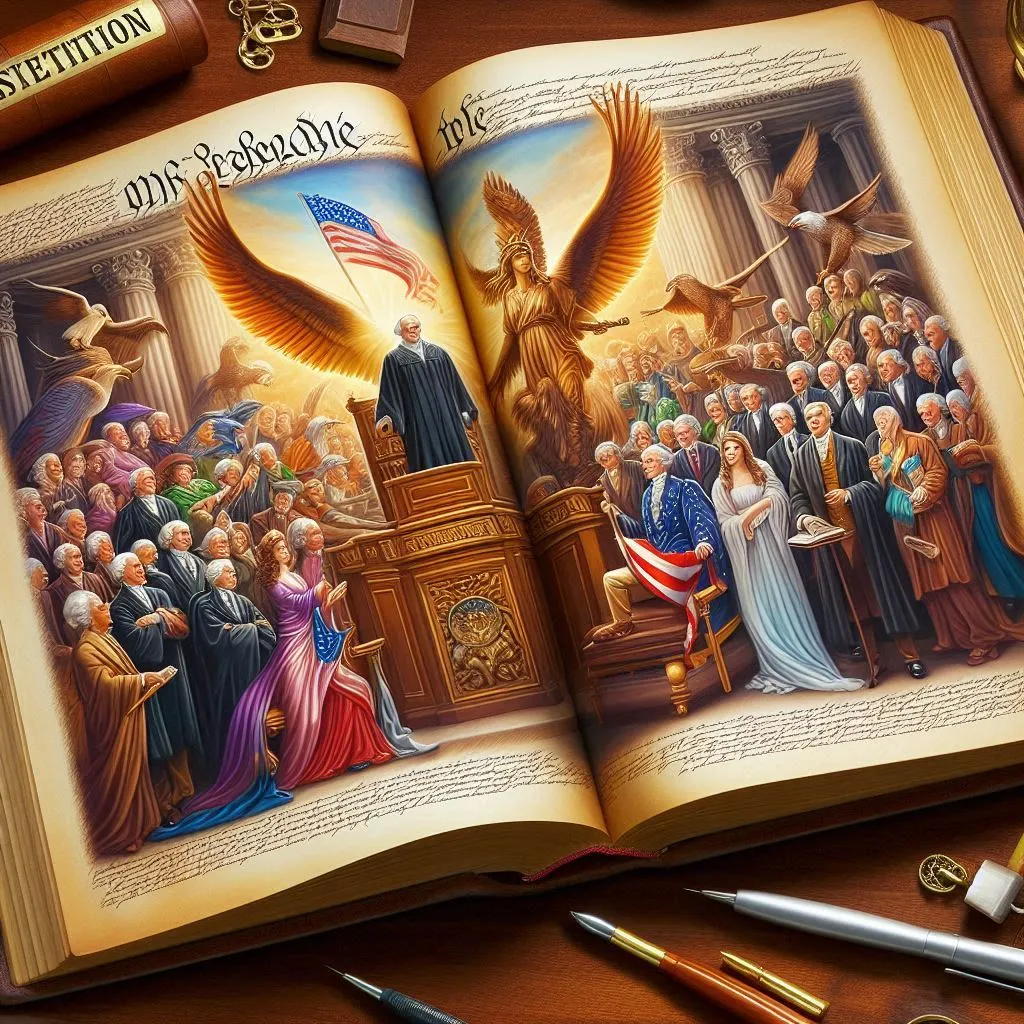
Introduction
Laws and principles shape the foundation of every nation, guiding rights, responsibilities, and governance. Understanding how constitutions work can be both fascinating and empowering, especially when explored in an engaging way.
Constitution Trivia Questions and Answers offer a fun and interactive approach to learning about legal systems, historic documents, and key amendments. Perfect for students, educators, or quiz enthusiasts, this collection turns important knowledge into an enjoyable challenge.
Get ready to test your understanding and discover interesting facts about constitutions from around the world.
Why Constitution Trivia Matters
The Constitution isn’t just a museum piece under glass at the National Archives; it is a living blueprint of American governance. Testing your knowledge on this document helps you understand how the balance of power works, how individual rights are protected, and how historic debates still echo in today’s political landscape. Plus, it makes for incredibly competitive trivia nights!
From the secret debates of the Constitutional Convention to the modern amendments that expanded voting rights, this quiz covers it all.
How to Play This Quiz
You can use this comprehensive trivia guide in several ways:
- Solo Challenge: Cover up the answers and explanations to see how many of the 120 questions you can answer correctly.
- Pub Trivia Night: Divide your friends into teams, appoint a trivia master, and read the questions aloud category by category.
- Classroom Flashcards: Teachers can use individual questions as daily history warm-ups or bonus exam questions.
Keep score to see where you rank:
- 100+ Correct: Constitutional Scholar (Supreme Court material!)
- 75–99 Correct: Founding Father/Mother Status
- 50–74 Correct: Solid Citizen
- Under 50 Correct: Time to re-read the Federalist Papers!
Easy Constitution Trivia Questions and Answers
1. Question: In what city was the United States Constitution framed and signed?
A. New York City, New York B. Philadelphia, Pennsylvania C. Washington, D.C. D. Boston, Massachusetts
Correct Answer: ✅ B. Philadelphia, Pennsylvania
Explanation: The Constitutional Convention met at the Pennsylvania State House, which is known today as Independence Hall. Delegates gathered there from May to September 1787 to scrap the failing Articles of Confederation and build a new government.
Interesting Fact: Independence Hall was also the exact building where the Declaration of Independence was signed eleven years earlier in 1776.
2. Question: Who is widely celebrated as the “Father of the Constitution”?
A. George Washington B. Thomas Jefferson C. James Madison D. Benjamin Franklin
Correct Answer: ✅ C. James Madison
Explanation: James Madison earned this title because he did the vast majority of the heavy lifting before and during the convention. He drafted the influential Virginia Plan, took meticulous daily notes of the debates, and co-authored the Federalist Papers to convince the states to approve it.
Interesting Fact: Despite his massive historical impact on American governance, Madison was the shortest US President in history, standing just 5 feet 4 inches tall and weighing about 100 pounds.
3. Question: What are the famous first three words of the US Constitution?
A. We the People B. In Congress, July C. Four score and D. When in the
Correct Answer: ✅ A. We the People
Explanation: The phrase “We the People” establishes the foundational concept of popular sovereignty. It signals immediately that the power of the government comes directly from its citizens, not from a king, a deity, or a collection of independent state governments.
Interesting Fact: The words “We the People” are written in a much larger, ornate script on the original document to catch the eye and emphasize the importance of public authority.
4. Question: What do we call the first ten amendments to the United States Constitution?
A. The Preamble B. The Articles of Confederation C. The Bill of Rights D. The Emancipation Proclamation
Correct Answer: ✅ C. The Bill of Rights
Explanation: The Bill of Rights was added to the Constitution in 1791 to satisfy Anti-Federalist critics who feared the new central government would be too powerful. These ten amendments explicitly outline specific protections for individual freedoms and state authority.
Interesting Fact: James Madison originally opposed adding a Bill of Rights because he believed listing specific rights might imply that any unlisted rights were not protected at all.
5. Question: How many branches of government does the US Constitution establish?
A. Two B. Three C. Four D. Five
Correct Answer: ✅ B. Three
Explanation: Articles I, II, and III of the Constitution establish a tripartite system consisting of the Legislative branch (Congress), the Executive branch (the President), and the Judicial branch (the Supreme Court). This structure was designed to ensure a balance of power.
Interesting Fact: The concept of separating government powers into three branches was heavily borrowed from the French political philosopher Montesquieu, who wrote about it in 1748.
6. Question: Which amendment protects freedom of speech, freedom of religion, and freedom of the press?
A. First Amendment B. Second Amendment C. Fourth Amendment D. Fifth Amendment
Correct Answer: ✅ A. First Amendment
Explanation: The First Amendment is the cornerstone of American civil liberties. It prohibits the federal government from establishing an official state religion and guarantees citizens the right to speak freely, publish news, assemble peacefully, and petition the government for changes.
Interesting Fact: The First Amendment actually protects five distinct freedoms: speech, religion, press, assembly, and petitioning the government.
7. Question: What is the minimum age required by the Constitution to serve as President of the United States?
A. 25 years old B. 30 years old C. 35 years old D. 40 years old
Correct Answer: ✅ C. 35 years old
Explanation: Article II, Section 1 of the Constitution establishes the age criteria for the presidency. The framers wanted to guarantee that anyone leading the nation would have a baseline of maturity and political experience.
Interesting Fact: Teddy Roosevelt became the youngest person to serve as president at age 42 after McKinley was assassinated, while John F. Kennedy was the youngest elected president at age 43.
8. Question: How many total amendments have been added to the US Constitution since its ratification?
A. 10 B. 21 C. 27 D. 33
Correct Answer: ✅ C. 27
Explanation: While thousands of amendments have been proposed since 1789, only 27 have successfully navigated the incredibly difficult two-stage amendment process requiring supermajorities in both Congress and the states.
Interesting Fact: The 27th Amendment, which deals with congressional pay raises, took a record-breaking 202 years, 7 months, and 2 days to be fully ratified after it was first proposed in 1789.
9. Question: Which branch of government has the sole constitutional power to declare war?
A. Executive Branch (The President) B. Judicial Branch (The Supreme Court) C. Legislative Branch (Congress) D. The Joint Chiefs of Staff
Correct Answer: ✅ C. Legislative Branch (Congress)
Explanation: Article I, Section 8 clearly grants Congress the exclusive power to formally declare war. While the President serves as Commander-in-Chief of the military, the framers intentionally gave the power to initiate war to the elected representatives of the people.
Interesting Fact: The United States has only passed formal declarations of war for five distinct conflicts in its entire history: the War of 1812, the Mexican-American War, the Spanish-American War, World War I, and World War II.
10. Question: What is the term length for a member of the United States Senate?
A. Two years B. Four years C. Six years D. Lifetime appointment
Correct Answer: ✅ C. Six years
Explanation: The framers designed the Senate to be a more stable, deliberative body than the House of Representatives. To shield senators from rapid shifts in public opinion, they were given longer, staggered six-year terms.
Interesting Fact: Every two years, exactly one-third of the Senate seats come up for election, ensuring that the chamber never completely changes overnight.
11. Question: What is the supreme law of the land in the United States?
A. The Declaration of Independence B. The Magna Carta C. The US Constitution D. The Emancipation Proclamation
Correct Answer: ✅ C. The US Constitution
Explanation: Article VI, Clause 2, commonly known as the Supremacy Clause, establishes that the Constitution, federal laws made pursuant to it, and treaties made under its authority constitute the highest level of law in the American legal system.
Interesting Fact: This means if any state law or state constitution conflicts with the federal Constitution, the state law is automatically void.
12. Question: Which amendment abolished slavery throughout the United States?
A. Eleventh Amendment B. Thirteenth Amendment C. Fourteenth Amendment D. Fifteenth Amendment
Correct Answer: ✅ B. Thirteenth Amendment
Explanation: Ratified in December 1865 at the close of the American Civil War, the Thirteenth Amendment formally outlawed slavery and involuntary servitude across the entire nation, except as a punishment for a crime whereof the party shall have been duly convicted.
Interesting Fact: President Abraham Lincoln played a massive role in pushing the 13th Amendment through Congress before the war ended, an effort dramatized in the famous 2012 film Lincoln.
13. Question: Who was the oldest delegate to sign the Constitution in 1787?
A. George Washington B. Alexander Hamilton C. Benjamin Franklin D. James Madison
Correct Answer: ✅ C. Benjamin Franklin
Explanation: Benjamin Franklin was 81 years old during the Constitutional Convention. Because of his advanced age and poor health, he often had to be carried to the sessions in a sedan chair by prisoners from a nearby jail.
Interesting Fact: Franklin was so frail and emotional near the end of the convention that he needed fellow Pennsylvania delegate James Wilson to read his final signing speech aloud for him.
14. Question: Which amendment gave women the right to vote across the United States?
A. Sixteenth Amendment B. Eighteenth Amendment C. Nineteenth Amendment D. Twenty-First Amendment
Correct Answer: ✅ C. Nineteenth Amendment
Explanation: Ratified in August 1920, the Nineteenth Amendment prohibited both the federal government and individual states from denying citizens the right to vote on account of sex, capping off decades of work by suffragists.
Interesting Fact: The deciding vote for ratification in the Tennessee legislature was cast by 24-year-old Harry Burn, who changed his vote to “yes” at the last second because his mother wrote him a letter telling him to “be a good boy” and vote for suffrage.
15. Question: How many voting members currently serve in the House of Representatives?
A. 100 B. 435 C. 538 D. 270
Correct Answer: ✅ B. 435
Explanation: While the Constitution states that seats must be apportioned based on population, the total number of representatives was permanently capped at 435 by the Permanent Apportionment Act of 1929 to keep the house manageable.
Interesting Fact: If the original constitutional ratio of one representative for every 30,000 citizens were still used today, the House of Representatives would have well over 11,000 members!
16. Question: Who serves as the official President of the Senate, according to the Constitution?
A. The Speaker of the House B. The Chief Justice of the Supreme Court C. The Vice President of the United States D. The Senate Majority Leader
Correct Answer: ✅ C. The Vice President of the United States
Explanation: Article I, Section 3 designates the Vice President as the President of the Senate. However, they have no vote in ordinary legislative matters unless the Senate is equally divided, in which case they cast the tie-breaking vote.
Interesting Fact: John Adams, the nation’s first Vice President, found this constitutional role deeply frustrating, once describing the vice presidency as “the most insignificant office that ever the invention of man contrived.”
17. Question: What is the introduction to the Constitution called?
A. The Postscript B. The Bill of Rights C. The Preamble D. The Appendix
Correct Answer: ✅ C. The Preamble
Explanation: The Preamble is a single, sweeping 52-word sentence that outlines the core purposes and philosophical goals of the document, such as establishing justice, ensuring domestic tranquility, and securing the blessings of liberty.
Interesting Fact: The Preamble holds no direct legal power in court; judges cannot rule a law unconstitutional based solely on the words of the Preamble.
18. Question: How long is the term of a federal Supreme Court Justice?
A. Four years B. Eight years C. Ten years D. Lifetime appointment during good behavior
Correct Answer: ✅ D. Lifetime appointment during good behavior
Explanation: Article III states that federal judges hold their offices “during good behavior.” This essentially means they have a lifetime appointment unless they choose to resign, retire, or are removed through the congressional impeachment process.
Interesting Fact: The lifetime tenure was designed intentionally to isolate judges from political pressures, ensuring they could make rulings based on law rather than worrying about winning re-election.
19. Question: Which amendment lowered the legal voting age from 21 to 18?
A. Twenty-Second Amendment B. Twenty-Fourth Amendment C. Twenty-Sixth Amendment D. Twenty-Seventh Amendment
Correct Answer: ✅ C. Twenty-Sixth Amendment
Explanation: Ratified rapidly in 1971 during the Vietnam War, the Twenty-Sixth Amendment was driven by the powerful public argument that young men who were old enough to be drafted and fight for their country should be old enough to vote.
Interesting Fact: This amendment holds the speed record for ratification, sailing through the required 38 states in just 100 days.
20. Question: What form of government does the Constitution explicitly guarantee to every state?
A. A Direct Democracy B. A Republican Form of Government C. A Parliamentary System D. An Oligarchy
Correct Answer: ✅ B. A Republican Form of Government
Explanation: Article IV, Section 4 contains the Guarantee Clause, which promises that the federal government will ensure every state is run as a republic—meaning a government where power is held by the people and exercised through elected representatives.
Interesting Fact: The Constitution does not actually contain the word “democracy” anywhere in its text; the framers deliberately preferred the term “republic.”
Recommended: 105+ Funny Monday Trivia Questions and Answers
Constitution Test Trivia Questions and Answers
21. Question: How many senators does each state receive under the Constitution?
A. Based on population size B. Exactly two C. Exactly four D. One for every million residents
Correct Answer: ✅ B. Exactly two
Explanation: To prevent highly populated states from completely dominating national politics, the Great Compromise guaranteed that every single state, regardless of land area or population, would have exactly two senators.
Interesting Fact: Because of this rule, Wyoming (population ~580,000) has the exact same voting power in the Senate as California (population ~39 million).
22. Question: Which amendment protects citizens against “unreasonable searches and seizures”?
A. Second Amendment B. Fourth Amendment C. Sixth Amendment D. Eighth Amendment
Correct Answer: ✅ B. Fourth Amendment
Explanation: The Fourth Amendment requires law enforcement to have probable cause and, in most scenarios, a written warrant approved by a judge before they can search a person’s property, home, or body.
Interesting Fact: This amendment was created in response to British “writs of assistance,” which were general warrants that allowed colonial tax collectors to enter any home at any time without reason.
23. Question: Who has the constitutional authority to nominate federal judges and Supreme Court Justices?
A. The Chief Justice B. The Senate Judiciary Committee C. The President of the United States D. State Governors
Correct Answer: ✅ C. The President of the United States
Explanation: Article II, Section 2 gives the President the power to nominate federal judges. However, this power is checked by the Senate, which must confirm the nominees by a simple majority vote.
Interesting Fact: George Washington holds the record for nominating the most Supreme Court Justices, successfully appointing 11 to the high court.
24. Question: What is the term length for a member of the House of Representatives?
A. Two years B. Four years C. Six years D. Variable based on state
Correct Answer: ✅ A. Two years
Explanation: Members of the House face re-election every two years. The framers intended for the House to be the branch closest to the everyday public, forcing representatives to constantly answer to their constituents.
Interesting Fact: Because their terms are so short, members of the House are essentially running for re-election the entire time they are in office.
25. Question: Which amendment is famous for protecting a person from being forced to testify against themselves in court?
A. Third Amendment B. Fifth Amendment C. Seventh Amendment D. Ninth Amendment
Correct Answer: ✅ B. Fifth Amendment
Explanation: The Fifth Amendment contains the privilege against self-incrimination. When someone says “I plead the Fifth,” they are exercising their constitutional right to remain silent so they do not utter anything that could be used to convict them of a crime.
Interesting Fact: The Fifth Amendment also protects citizens from “double jeopardy” (being tried twice for the exact same crime) and establishes the rule of “due process.”
26. Question: Who was chosen to preside as the President of the Constitutional Convention?
A. Benjamin Franklin B. John Adams C. George Washington D. Alexander Hamilton
Correct Answer: ✅ C. George Washington
Explanation: George Washington was unanimously elected to chair the convention. His presence lent immediate legitimacy and gravity to the meetings, keeping the highly passionate delegates cooperative and focused.
Interesting Fact: Washington rarely spoke during the actual debates, but his quiet authority from the front podium held the fracturing convention together through dark moments.
27. Question: Which body acts as the court during an impeachment trial of a President?
A. The Supreme Court B. The House of Representatives C. The United States Senate D. The Department of Justice
Correct Answer: ✅ C. The United States Senate
Explanation: While the House of Representatives holds the power to “impeach” (bring formal charges against) an official, the Senate acts as the jury and court. A two-thirds supermajority vote in the Senate is required to remove an impeached president from office.
Interesting Fact: When a US President is put on trial for impeachment in the Senate, the Chief Justice of the Supreme Court travels over to preside as the judge.
28. Question: How many states had to ratify the Constitution for it to officially take effect?
A. All 13 states B. 9 out of 13 states C. 7 out of 13 states D. A simple majority of voters
Correct Answer: ✅ B. 9 out of 13 states
Explanation: Article VII of the Constitution specified that once 9 of the original 13 states ratified the document via special state conventions, it would become active for those specific states. New Hampshire became the crucial 9th state on June 21, 1788.
Interesting Fact: The previous government framework, the Articles of Confederation, required a 100% unanimous vote from all 13 states to make changes, which had made governance completely paralyzed.
29. Question: Which amendment banned the manufacture, sale, and transportation of intoxicating liquors?
A. Sixteenth Amendment B. Eighteenth Amendment C. Twentieth Amendment D. Twenty-First Amendment
Correct Answer: ✅ B. Eighteenth Amendment
Explanation: Ratified in 1919, the Eighteenth Amendment ushered in the historical era known as Prohibition. It is the only amendment in American history focused entirely on restricting a social beverage rather than organizing government power or protecting rights.
Interesting Fact: While the amendment banned the sale, production, and transit of alcohol, it did not actually outlaw the physical act of drinking or possessing it.
30. Question: Which amendment repealed Prohibition and made alcohol legal again?
A. Nineteenth Amendment B. Twentieth Amendment C. Twenty-First Amendment D. Twenty-Second Amendment
Correct Answer: ✅ C. Twenty-First Amendment
Explanation: Ratified in late 1933, the Twenty-First Amendment officially overturned the Eighteenth Amendment, ending Prohibition after fourteen years of widespread public defiance and a massive rise in organized crime syndicates.
Interesting Fact: This is the only amendment in US history that was ratified by special state conventions rather than state legislatures, a path chosen to bypass politicians who feared backlash from temperance voters.
31. Question: What is the only crime explicitly defined within the text of the US Constitution?
A. Murder B. Piracy C. Treason D. Counterfeiting
Correct Answer: ✅ C. Treason
Explanation: Article III, Section 3 explicitly defines treason as levying war against the United States or giving aid and comfort to their enemies. The framers defined it narrowly to prevent future leaders from using vague “treason” charges to lock up political opponents.
Interesting Fact: To convict someone of treason, the Constitution requires the testimony of at least two eyewitnesses to the exact same overt act, or a wide-open confession in an open courtroom.
32. Question: Which amendment protects citizens from “cruel and unusual punishments”?
A. Fifth Amendment B. Sixth Amendment C. Seventh Amendment D. Eighth Amendment
Correct Answer: ✅ D. Eighth Amendment
Explanation: The Eighth Amendment bans excessive bail, excessive fines, and cruel and unusual punishments. It serves as a check on the judicial system to ensure penalties match the gravity of crimes committed.
Interesting Fact: The wording of the Eighth Amendment was lifted nearly word-for-word from the English Bill of Rights written back in 1689.
33. Question: If both the President and the Vice President die or are incapacitated, who is next in line for the presidency according to constitutional law and statutory succession?
A. The Secretary of State B. The Secretary of Defense C. The Speaker of the House D. The Senate President Pro Tempore
Correct Answer: ✅ C. The Speaker of the House
Explanation: While the Constitution gives Congress the power to set the line of succession, the Presidential Succession Act of 1947 establishes that the Speaker of the House is next in line after the Vice President, followed by the Senate President Pro Tempore.
Interesting Fact: No Speaker of the House has ever had to ascend to the presidency via this line of succession in American history.
34. Question: Which amendment limits a President to serving only two terms in office?
A. Twentieth Amendment B. Twenty-Second Amendment C. Twenty-Third Amendment D. Twenty-Fifth Amendment
Correct Answer: ✅ B. Twenty-Second Amendment
Explanation: Passed in 1947 and ratified in 1951, the Twenty-Second Amendment formalized the traditional two-term limit established by George Washington. It was passed in response to Franklin D. Roosevelt winning four consecutive presidential elections.
Interesting Fact: Had the amendment been active during the mid-19th century, popular presidents like Ulysses S. Grant might have faced legal hurdles when considering third-term runs.
35. Question: What is the minimum age required by the Constitution to serve as a member of the United States Senate?
A. 21 years old B. 25 years old C. 30 years old D. 35 years old
Correct Answer: ✅ C. 30 years old
Explanation: Article I, Section 3 requires a senator to be at least 30 years old, a US citizen for 9 years, and an inhabitant of the state they represent at the time of election.
Interesting Fact: President Joe Biden was elected to the Senate at age 29 in 1972, but he turned 30 before he was officially sworn into office in January 1973, meeting the constitutional requirement.
36. Question: Which basic right is protected by the Second Amendment?
A. The right to a fair trial B. The right to keep and bear arms C. The right to refuse housing soldiers D. The right to vote
Correct Answer: ✅ B. The right to keep and bear arms
Explanation: The Second Amendment states: “A well regulated Militia, being necessary to the security of a free State, the right of the people to keep and bear Arms, shall not be infringed.” It remains one of the most intensely debated sentences in constitutional law.
Interesting Fact: The Supreme Court clarified in the landmark 2008 case District of Columbia v. Heller that the amendment protects an individual’s right to own a firearm for self-defense unconnected to service in a militia.
37. Question: Who was the first person to sign the US Constitution?
A. John Hancock B. George Washington C. Thomas Jefferson D. Alexander Hamilton
Correct Answer: ✅ B. George Washington
Explanation: As President of the Constitutional Convention, George Washington was the first delegate to step up and sign his name to the completed scroll on September 17, 1787.
Interesting Fact: Many people mistake John Hancock as a signer of the Constitution, but he never attended the convention; his famous giant signature is on the Declaration of Independence.
38. Question: Which amendment guarantees the right to a speedy and public trial by an impartial jury in criminal cases?
A. Fifth Amendment B. Sixth Amendment C. Seventh Amendment D. Eighth Amendment
Correct Answer: ✅ B. Sixth Amendment
Explanation: The Sixth Amendment sets up essential ground rules for criminal trials, ensuring defendants aren’t locked up indefinitely without a trial, know what crimes they are accused of, can confront witnesses, and have the right to a defense lawyer.
Interesting Fact: The right to a court-appointed lawyer for poor defendants wasn’t fully guaranteed across all states until the Supreme Court’s landmark Gideon v. Wainwright ruling in 1963.
39. Question: What percentage of votes in both houses of Congress is required to propose a constitutional amendment?
A. A simple majority (51%) B. A three-fifths majority (60%) C. A two-thirds majority (66.7%) D. A three-quarters majority (75%)
Correct Answer: ✅ C. A two-thirds majority (66.7%)
Explanation: Article V requires a two-thirds vote in both the House of Representatives and the Senate just to formally propose an amendment to the states for consideration.
Interesting Fact: Alternatively, two-thirds of state legislatures can petition Congress to call a national convention to propose amendments, though this secondary method has never been used.
40. Question: Which amendment ensures that any powers not explicitly given to the federal government belong to the states or the people?
A. First Amendment B. Third Amendment C. Ninth Amendment D. Tenth Amendment
Correct Answer: ✅ D. Tenth Amendment
Explanation: The Tenth Amendment establishes the core principle of federalism. It acts as a protective boundary line, making it clear that the federal government only possesses the specific powers listed in the Constitution, leaving the rest to local control.
Interesting Fact: This amendment is often called the “States’ Rights Amendment” and serves as the legal foundation for states creating their own unique laws regarding education, driving, and local policing.
Recommended: 115+ Interesting 4th of July Facts
Us Constitution Trivia Questions and Answers
41. Question: What is the minimum number of years a person must be a US citizen to be eligible for election to the House of Representatives?
A. 5 years B. 7 years C. 9 years D. Permanent natural-born citizen status
Correct Answer: ✅ B. 7 years
Explanation: Article I, Section 2 requires a Representative to be at least 25 years old, a citizen of the United States for at least 7 years, and a resident of the state they represent. This is shorter than the 9-year citizenship rule required for the Senate.
Interesting Fact: This rule meant early European immigrants who supported the American Revolution could run for House seats relatively soon after the nation’s founding.
42. Question: Which clause in Article I gives Congress the flexibility to pass laws necessary for carrying out its listed powers?
A. The Commerce Clause B. The Elastic Clause C. The Supremacy Clause D. The Full Faith and Credit Clause
Correct Answer: ✅ B. The Elastic Clause
Explanation: Article I, Section 8, Clause 18 is formally called the Necessary and Proper Clause, but it is nicknamed the “Elastic Clause” because it allows congressional power to stretch and adapt to modern issues that the founders could never have anticipated.
Interesting Fact: Alexander Hamilton used this exact clause to justify creating the first National Bank, arguing that a bank was necessary to collect taxes and manage national funds.
43. Question: The Third Amendment prohibits the government from forcing citizens to house soldiers. What historic British laws prompted this protection?
A. The Stamp Acts B. The Quartering Acts C. The Townshend Acts D. The Declaratory Acts
Correct Answer: ✅ B. The Quartering Acts
Explanation: Before the Revolutionary War, the British Parliament passed the Quartering Acts, forcing American colonists to provide food, housing, and firewood to British imperial troops stationed in the colonies, which caused massive public outrage.
Interesting Fact: The Third Amendment is the least litigated amendment in the entire Bill of Rights, having almost never been the central focus of a major Supreme Court ruling.
44. Question: Which amendment altered the Electoral College so that electors must cast separate, distinct votes for President and Vice President?
A. Eleventh Amendment B. Twelfth Amendment C. Fourteenth Amendment D. Seventeenth Amendment
Correct Answer: ✅ B. Twelfth Amendment
Explanation: Originally, electors voted for two people; the winner became president and the runner-up became vice president. This caused chaos in the election of 1800 when Thomas Jefferson and his running mate Aaron Burr tied, forcing the ratification of the 12th Amendment in 1804.
Interesting Fact: Before this amendment, political rivals could end up stuck in the executive branch together, which is exactly what happened in 1796 when Federalist John Adams had to work with Democratic-Republican Thomas Jefferson.
45. Question: What constitutional power allows a President to kill a bill passed by Congress simply by refusing to sign it during a congressional recess?
A. Line-item veto B. Pocket veto C. Executive decree D. Proportional veto
Correct Answer: ✅ B. Pocket veto
Explanation: If Congress sends a bill to the President and then adjourns their session within 10 days, the President can simply ignore the bill, letting it die without giving a formal veto message. This is called a “pocket veto.”
Interesting Fact: James Madison was the first president to use a pocket veto, employing it in 1812 to kill a bill regarding naturalization laws.
46. Question: Which landmark constitutional amendment contains the Equal Protection Clause, which served as the legal basis for dismantling racial segregation?
A. Thirteenth Amendment B. Fourteenth Amendment C. Fifteenth Amendment D. Nineteenth Amendment
Correct Answer: ✅ B. Fourteenth Amendment
Explanation: Ratified in 1868 to secure the rights of newly freed slaves, the 14th Amendment’s Equal Protection Clause mandates that no state can deny any person within its borders “the equal protection of the laws.” This clause was central to Brown v. Board of Education.
Interesting Fact: The 14th Amendment also explicitly defined birthright citizenship, ensuring that anyone born on US soil is automatically a full citizen.
47. Question: How were US Senators originally chosen before the Seventeenth Amendment was ratified in 1913?
A. By direct popular vote of the citizens B. By appointments from the President C. By selections from state legislatures D. By a lottery system among wealthy landowners
Correct Answer: ✅ C. By selections from state legislatures
Explanation: The original Constitution stated that senators were chosen by the legislatures of their respective states. This was done to give state governments a direct voice and check inside the federal apparatus.
Interesting Fact: By the late 19th century, this system led to rampant political bribery and deadlocked state legislatures, earning the Senate the nickname “The Millionaires’ Club.”
48. Question: Which amendment authorized Congress to levy a nationwide federal income tax without distributing it among the states based on population?
A. Fifteenth Amendment B. Sixteenth Amendment C. Seventeenth Amendment D. Eighteenth Amendment
Correct Answer: ✅ B. Sixteenth Amendment
Explanation: Before the Sixteenth Amendment was ratified in 1913, the Supreme Court had struck down federal income taxes as unconstitutional “direct taxes” that weren’t properly apportioned among the states by population size.
Interesting Fact: When the income tax was first introduced following the amendment, less than 1% of the American population actually had to pay it due to high personal exemption limits.
49. Question: What constitutional protection stops the government from passing a law that declares a specific person guilty of a crime and punishes them without a trial?
A. Habeas Corpus B. Bill of Attainder C. Ex Post Facto law D. Double Jeopardy
Correct Answer: ✅ B. Bill of Attainder
Explanation: Article I, Sections 9 and 10 explicitly forbid both Congress and individual states from passing a “Bill of Attainder.” This ensures that determining guilt remains exclusively with the judicial branch through a fair trial.
Interesting Fact: British monarchs frequently used Bills of Attainder to quickly execute political enemies and seize their ancestral estates without having to prove anything in court.
50. Question: What does an “Ex Post Facto” law mean, as prohibited by the Constitution?
A. A law that allows a person to be tried twice for the same crime B. A law that punishes someone for an action that was legal when they did it C. A law passed by a state that overrides a federal treaty D. A law that permits imprisonment without an official warrant
Correct Answer: ✅ B. A law that punishes someone for an action that was legal when they did it
Explanation: The Constitution bans Ex Post Facto laws. This means if you perform an action today that is perfectly legal, and the government passes a law tomorrow making it illegal, they cannot retroactively arrest or punish you for your past action.
Interesting Fact: This protection applies strictly to criminal laws; civil laws (like tax changes) can sometimes have retroactive economic impacts.
51. Question: Which clause in Article IV requires states to respect and recognize the public acts, records, and judicial proceedings of other states?
A. Commerce Clause B. Privileges and Immunities Clause C. Full Faith and Credit Clause D. Supremacy Clause
Correct Answer: ✅ C. Full Faith and Credit Clause
Explanation: The Full Faith and Credit Clause ensures that legal documents like marriage licenses, wills, contracts, and court judgments remain fully valid and binding when a citizen drives across state lines.
Interesting Fact: This clause was historically vital in ensuring that civil judgments and debts could not be escaped simply by moving to a neighboring state.
52. Question: How many delegates actually signed the finished United States Constitution on September 17, 1787?
A. 39 delegates B. 55 delegates C. 13 delegates D. 100 delegates
Correct Answer: ✅ A. 39 delegates
Explanation: While 55 delegates attended various parts of the Constitutional Convention throughout the hot summer, only 39 actually put their signatures on the final parchment document. Some had left early, and three refused to sign it on principle.
Interesting Fact: The 39 signers represented 12 states; Rhode Island completely boycotted the convention, refusing to send a single delegate to Philadelphia.
53. Question: Which amendment protects a person’s right to a jury trial in civil cases involving disputes over property or money above a certain value?
A. Fifth Amendment B. Sixth Amendment C. Seventh Amendment D. Ninth Amendment
Correct Answer: ✅ C. Seventh Amendment
Explanation: While the Sixth Amendment handles criminal cases, the Seventh Amendment preserves the historical right to a jury trial in traditional federal civil lawsuits, like contract disputes or personal injury claims, provided the amount in dispute exceeds 20 dollars.
Interesting Fact: The 20-dollar threshold has never been changed by an amendment, but federal courts today generally won’t hear civil cases unless the financial dispute is much higher.
54. Question: What is the text of the Ninth Amendment designed to protect?
A. The right to vote regardless of race B. Rights held by the people that aren’t explicitly listed in the Constitution C. The right of states to print their own local currencies D. The exact rules for presidential succession
Correct Answer: ✅ B. Rights held by the people that aren’t explicitly listed in the Constitution
Explanation: The Ninth Amendment states that just because certain rights are listed in the Bill of Rights, it doesn’t mean the people don’t have other, unlisted rights. It serves as a safety net to protect fundamental human freedoms like privacy.
Interesting Fact: Supreme Court Justices have used the Ninth Amendment to argue that citizens possess a fundamental right to privacy, even though the word “privacy” does not appear anywhere in the Constitution.
55. Question: Which amendment moved the official Presidential Inauguration day from March 4th to January 20th?
A. Nineteenth Amendment B. Twentieth Amendment C. Twenty-Second Amendment D. Twenty-Third Amendment
Correct Answer: ✅ B. Twentieth Amendment
Explanation: Ratified in 1933, the Twentieth Amendment is known as the “Lame Duck Amendment.” It shortened the long, inefficient four-month gap between the November election and inauguration, ensuring incoming leaders could take charge faster during crises.
Interesting Fact: The long transition gap was originally necessary in the 18th century because it took months for politicians to pack up, settle their affairs, and travel to the capital by horse and carriage.
56. Question: What constitutional writ protects against illegal imprisonment by demanding law enforcement bring a prisoner before a judge to explain why they are being held?
A. Writ of Mandamus B. Writ of Certiorari C. Writ of Habeas Corpus D. Writ of Execution
Correct Answer: ✅ C. Writ of Habeas Corpus
Explanation: Known as the “Great Writ,” Habeas Corpus (Latin for “you shall have the body”) is protected in Article I, Section 9. It stops a government from secretly locking up citizens indefinitely without charging them with a crime.
Interesting Fact: The Constitution states Habeas Corpus can only be suspended during times of absolute emergency, such as a foreign invasion or an active rebellion.
57. Question: Which amendment granted residents of Washington, D.C., the right to vote in presidential elections by awarding the district electors in the Electoral College?
A. Twenty-First Amendment B. Twenty-Third Amendment C. Twenty-Fifth Amendment D. Twenty-Seventh Amendment
Correct Answer: ✅ B. Twenty-Third Amendment
Explanation: Ratified in 1961, the Twenty-Third Amendment gave citizens living in the nation’s capital a voice in presidential races, granting Washington, D.C., the same number of electors as the least populated state (three electors).
Interesting Fact: Despite having electoral votes for the president, Washington, D.C., still does not have voting representatives or senators inside Congress.
58. Question: Which amendment banned the use of poll taxes, which were financial charges used to block poor Black citizens from voting?
A. Twenty-Second Amendment B. Twenty-Third Amendment C. Twenty-Fourth Amendment D. Twenty-Fifth Amendment
Correct Answer: ✅ C. Twenty-Fourth Amendment
Explanation: Ratified in 1964 during the height of the Civil Rights Movement, the Twenty-Fourth Amendment knocked down poll taxes in federal elections, removing a major structural tool used by Southern states to suppress minority voters.
Interesting Fact: Some states tried to bypass this amendment by keeping poll taxes active for local and state elections, but the Supreme Court crushed that practice completely in 1966.
59. Question: What baseline percentage of states must approve a proposed constitutional amendment for it to be fully ratified?
A. Two-thirds (66.7%) B. Three-fifths (60%) C. Three-quarters (75%) D. A simple majority (51%)
Correct Answer: ✅ C. Three-quarters (75%)
Explanation: Article V states that a proposed amendment must be formally approved by the legislatures or special conventions of three-quarters of the states before it becomes active law. Today, that means 38 out of 50 states must say “yes.”
Interesting Fact: Because the 75% bar is so high, more than 11,000 amendments have been introduced in Congress throughout history, but only 27 made it across the finish line.
60. Question: Which individual served as the official administrative secretary of the Constitutional Convention, keeping the formal journal?
A. William Jackson B. Thomas Lloyd C. Charles Thomson D. Robert Morris
Correct Answer: ✅ A. William Jackson
Explanation: William Jackson was elected by the delegates to act as the official secretary. Unfortunately, Jackson kept very sparse, basic records that only tracked specific resolutions and votes, rather than detailed summaries of arguments.
Interesting Fact: Because Jackson’s official records were so thin, historians rely almost completely on the private, detailed journals kept secretly by James Madison to understand what actually went on.
Recommended: 150+ Fun 4th of July Quiz Questions with Answers
Hard Constitution Trivia Questions and Answers
61. Question: What does the “Origination Clause” in Article I dictate about bills designed to raise tax revenue?
A. They must be approved by the President first B. They must originate exclusively in the House of Representatives C. They must originate exclusively in the Senate D. They require a 100% unanimous vote from all states
Correct Answer: ✅ B. They must originate exclusively in the House of Representatives
Explanation: Article I, Section 7 dictates that all bills for raising revenue must start in the House of Representatives. The framers felt that since the House was directly elected by local voters, it should hold the primary keys to the public’s wallet.
Interesting Fact: The Senate can still completely alter, amend, or rewrite tax bills once they receive them from the House, effectively bypassing the spirit of the rule in modern times.
62. Question: Which amendment established clear procedures for what happens if a President becomes disabled, and how to fill a vacancy in the vice presidency?
A. Twenty-Third Amendment B. Twenty-Fourth Amendment C. Twenty-Fifth Amendment D. Twenty-Sixth Amendment
Correct Answer: ✅ C. Twenty-Fifth Amendment
Explanation: Ratified in 1967 following the assassination of John F. Kennedy, the Twenty-Fifth Amendment created a clear legal path for a Vice President to temporarily take over as Acting President if the Chief Executive undergoes surgery or becomes incapacitated.
Interesting Fact: This amendment has been used temporarily when presidents have undergone routine colonoscopies, briefly passing power over to their vice presidents.
63. Question: The “Emoluments Clause” in Article I of the Constitution restricts federal officials from accepting what?
A. Free campaign advertising from local media companies B. Titles of nobility, gifts, or offices from foreign countries C. Financial loans from domestic commercial banks D. Land grants from individual state governments
Correct Answer: ✅ B. Titles of nobility, gifts, or offices from foreign countries
Explanation: Article I, Section 9 contains the Foreign Emoluments Clause. It was designed to keep American diplomats, generals, and presidents perfectly loyal to the United States, preventing foreign empires from buying influence with lavish gifts or titles.
Interesting Fact: Benjamin Franklin famously had to ask permission from Congress to keep a luxurious, diamond-encrusted snuffbox given to him as a parting gift by the King of France.
64. Question: What historical plan proposed at the convention wanted a unicameral legislature where every state got one vote, favoring small states?
A. The Virginia Plan B. The New Jersey Plan C. The Connecticut Plan D. The Hamilton Plan
Correct Answer: ✅ B. The New Jersey Plan
Explanation: Introduced by William Paterson, the New Jersey Plan sought to modify the Articles of Confederation while keeping states perfectly equal in voting power. It stood in direct opposition to the population-based Virginia Plan.
Interesting Fact: The fierce battle between the Virginia and New Jersey plans nearly broke the convention apart before the Great Compromise combined elements of both.
65. Question: What historic compromise at the convention determined how enslaved individuals would be counted for taxation and congressional representation?
A. The Great Compromise B. The Three-Fifths Compromise C. The Commerce Compromise D. The Missouri Compromise
Correct Answer: ✅ B. The Three-Fifths Compromise
Explanation: The Three-Fifths Compromise stated that five enslaved individuals would count as three free people when calculating a state’s total population for House seats and direct taxes. This gave Southern slave states vastly inflated political power.
Interesting Fact: This compromise was eventually completely erased and nullified by the ratification of the 14th Amendment following the Civil War.
66. Question: Who was the only delegate from New York to sign the finished Constitution?
A. John Jay B. Gouverneur Morris C. Alexander Hamilton D. George Clinton
Correct Answer: ✅ C. Alexander Hamilton
Explanation: New York’s other two delegates, Robert Yates and John Lansing, walked out of the convention early because they believed the meetings were illegally overstepping their boundaries, leaving Alexander Hamilton as the sole New York representative to sign.
Interesting Fact: Because Hamilton was the only New York delegate left, New York technically lost its official state vote under the convention’s procedural rules, but Hamilton signed anyway as an individual.
67. Question: Which amendment protects a person from having private property taken for public use without “just compensation”?
A. Fourth Amendment B. Fifth Amendment C. Sixth Amendment D. Fourteenth Amendment
Correct Answer: ✅ B. Fifth Amendment
Explanation: This specific section of the Fifth Amendment handles “eminent domain.” While the government holds the structural right to take your private land to build a public highway or school, they are legally forced to pay you a fair market price for it.
Interesting Fact: Eminent domain cases remain highly controversial, especially when local governments seize land to give to private developers under the claim that it will boost local tax revenue.
68. Question: What is the minimum number of presidential electors a state can possibly have in the Electoral College?
A. One B. Two C. Three D. Four
Correct Answer: ✅ C. Three
Explanation: The Constitution states that a state’s total number of electors equals its total number of Senators (always two) plus its total number of House Representatives (at least one). Therefore, even the smallest states start with a baseline of three.
Interesting Fact: There are currently six states—Alaska, Delaware, North Dakota, South Dakota, Vermont, and Wyoming—along with Washington, D.C., that possess the bare minimum of three electoral votes.
69. Question: Which individual actually put the physical ink to parchment, using fine calligraphy to write out the official copy of the Constitution?
A. Jacob Shallus B. Timothy Pickering C. Thomas Jefferson D. James Madison
Correct Answer: ✅ A. Jacob Shallus
Explanation: Jacob Shallus was an assistant clerk for the Pennsylvania General Assembly. He was paid exactly 30 dollars (about 900 dollars today) to carefully engross the text onto four large sheets of animal parchment over a single weekend.
Interesting Fact: Shallus accidentally left out a line of text on sheet two, forcing him to carefully errata and insert the missing words using a small caret mark at the bottom of the page.
70. Question: Which amendment was the first to extend voting rights by prohibiting discrimination based on “race, color, or previous condition of servitude”?
A. Thirteenth Amendment B. Fourteenth Amendment C. Fifteenth Amendment D. Nineteenth Amendment
Correct Answer: ✅ C. Fifteenth Amendment
Explanation: Ratified in 1870 during Reconstruction, the Fifteenth Amendment sought to guarantee voting rights for newly freed Black men. However, Southern states quickly used literacy tests and poll taxes to bypass its protections for nearly a century.
Interesting Fact: Despite securing voting rights for Black men, the 15th Amendment completely left out women of all races, sparking a deep rift in the early civil rights and suffrage movements.
71. Question: If no presidential candidate wins a clear majority in the Electoral College, who chooses the President?
A. The Supreme Court B. The House of Representatives C. The Senate D. A nationwide popular runoff vote
Correct Answer: ✅ B. The House of Representatives
Explanation: Under the 12th Amendment, if there is a tie or no candidate hits a majority, the election goes to the House of Representatives. Crucially, each state delegation gets one vote, meaning representatives must vote as a unified state block.
Interesting Fact: The House of Representatives has chosen the President twice in American history: selecting Thomas Jefferson in 1801 and John Quincy Adams in 1824.
72. Question: Which clause in Article IV ensures that a citizen of one state gets the same basic legal protections when traveling through another state?
A. Full Faith and Credit Clause B. Commerce Clause C. Privileges and Immunities Clause D. Supremacy Clause
Correct Answer: ✅ C. Privileges and Immunities Clause
Explanation: The Privileges and Immunities Clause stops states from treating out-of-state visitors like hostile foreigners. For example, a state cannot impose harsher criminal penalties on a traveler than it would on a local citizen for the exact same offense.
Interesting Fact: States can still charge higher rates for out-of-state college tuition or hunting licenses because those aren’t considered fundamental constitutional rights.
73. Question: What historical year did the United States Constitution officially go into effect, replacing the Articles of Confederation?
A. 1776 B. 1787 C. 1789 D. 1791
Correct Answer: ✅ C. 1789
Explanation: While the document was written and signed in 1787, it took time to achieve the required state ratifications. The new federal government officially began operations on March 4, 1789.
Interesting Fact: The first Congress struggled to get a quorum together on March 4, 1789, due to poor travel conditions, delaying the official counting of electoral votes for George Washington by several weeks.
74. Question: Which amendment protected individual states from being sued in federal court by citizens of other states or foreign countries?
A. Eleventh Amendment B. Twelfth Amendment C. Thirteenth Amendment D. Fourteenth Amendment
Correct Answer: ✅ A. Eleventh Amendment
Explanation: Ratified in 1795, the Eleventh Amendment was passed to overturn a Supreme Court ruling (Chisholm v. Georgia) that allowed citizens to drag state governments into federal court over financial debts, reinforcing state sovereignty.
Interesting Fact: This was the very first amendment passed specifically to strike down a direct ruling made by the United States Supreme Court.
75. Question: What major constitutional power allows Congress to regulate economic trade between states and with foreign nations?
A. The Elastic Clause B. The Commerce Clause C. The Taxing and Spending Clause D. The Supremacy Clause
Correct Answer: ✅ B. The Commerce Clause
Explanation: Found in Article I, Section 8, the Interstate Commerce Clause gives Congress the power to regulate business transactions that cross state borders. It has been used to justify federal laws on civil rights, environmental protection, and labor rules.
Interesting Fact: In the 1942 case Wickard v. Filburn, the Supreme Court ruled that Congress could even regulate a farmer growing wheat entirely for his own cows, arguing it indirectly affected the national wheat market.
76. Question: Who was the prominent Anti-Federalist leader who refused to attend the convention, famously stating that he “smelt a rat”?
A. Patrick Henry B. Samuel Adams C. Thomas Jefferson D. John Hancock
Correct Answer: ✅ A. Patrick Henry
Explanation: Patrick Henry, famous for saying “Give me liberty, or give me death!”, was chosen as a delegate for Virginia but flatly refused to go. He correctly suspected that the convention would try to replace the states with a dominant central government.
Interesting Fact: Henry later became one of the leading voices fighting against the ratification of the Constitution, demanding a Bill of Rights be added before he would support it.
77. Question: What is the name of the constitutional protection that says the President cannot be tried or punished by a court while they are actively in office?
A. Executive Privilege B. Sovereign Immunity C. Temporary Executive Immunity D. Diplomatic Absolution
Correct Answer: ✅ C. Temporary Executive Immunity
Explanation: While the specific term isn’t in the text, structural constitutional law and Department of Justice policy dictate that a sitting president cannot face criminal indictment or prosecution while in office, as it would paralyze the executive branch.
Interesting Fact: A president can still face civil lawsuits for actions taken before they took office, a rule established by the Supreme Court in the 1997 case Clinton v. Jones.
78. Question: Which article of the Constitution lays out the specific instructions for how the document can be amended?
A. Article IV B. Article V C. Article VI D. Article VII
Correct Answer: ✅ B. Article V
Explanation: Article V outlines the dual-step process of amendment: proposal (by two-thirds of Congress or state conventions) followed by ratification (by three-quarters of state legislatures or state conventions).
Interesting Fact: Article V included a special lock rule stating that no amendment passed before 1808 could outlaw or restrict the international slave trade.
79. Question: Which delegate wrote the final elegant literary prose of the Preamble and organized the document into its seven clean articles?
A. James Madison B. Gouverneur Morris C. Alexander Hamilton D. Roger Sherman
Correct Answer: ✅ B. Gouverneur Morris
Explanation: Gouverneur Morris served on the Convention’s “Committee of Style.” He was responsible for taking the various agreed-upon resolutions and smoothing them out into polished, clear, and powerful English prose.
Interesting Fact: Morris had a wooden leg due to a carriage accident, but he was known as one of the most brilliant, outspoken, and witty speakers at the entire convention.
80. Question: What famous collection of 85 political essays was written under the fake pen name “Publius” to convince voters to ratify the Constitution?
A. The Anti-Federalist Papers B. The Federalist Papers C. Common Sense D. The Letters of Brutus
Correct Answer: ✅ B. The Federalist Papers
Explanation: Written by Alexander Hamilton, James Madison, and John Jay, the Federalist Papers provided an in-depth, brilliant explanation of how the new proposed government would work, aiming to calm fears of tyranny.
Interesting Fact: Alexander Hamilton wrote the lion’s share of the essays, single-handedly penning 51 of the 85 essays over a blistering span of months.
Recommended: 127+ Pennsylvania Trivia Questions and Answers
Funny Constitution Trivia Questions and Answers
81. Question: Which clause in Article VI states that no religious test shall ever be required as a qualification to hold any public office in the United States?
A. The Establishment Clause B. The Free Exercise Clause C. The No Religious Test Clause D. The Supremacy Clause
Correct Answer: ✅ C. The No Religious Test Clause
Explanation: Found in Article VI, Clause 3, this revolutionary clause broke away from European traditions by legally banning the government from forcing politicians to belong to a specific church or swear a specific religious oath to hold power.
Interesting Fact: At the time of writing in 1787, several individual states still had active laws requiring state politicians to be Christians or Protestants to hold local office.
82. Question: Who were the three delegates present at the very end of the Constitutional Convention who flatly refused to sign the finished document?
A. Elbridge Gerry, George Mason, and Edmund Randolph B. Patrick Henry, Samuel Adams, and John Hancock C. Robert Yates, John Lansing, and Luther Martin D. Alexander Hamilton, James Madison, and John Dickinson
Correct Answer: ✅ A. Elbridge Gerry, George Mason, and Edmund Randolph
Explanation: These three delegates, despite staying through the entire hot summer, refused to sign on September 17, 1787, because they felt the document granted too much centralized power and desperately lacked a protective Bill of Rights.
Interesting Fact: Elbridge Gerry’s name later became the root of the word “gerrymandering” due to an oddly shaped, politically distorted voting district he approved years later as Governor of Massachusetts.
83. Question: The “Take Care Clause” is a vital source of presidential executive power. In which article of the Constitution is it located?
A. Article I B. Article II C. Article III D. Article IV
Correct Answer: ✅ B. Article II
Explanation: Located in Article II, Section 3, the clause commands that the President “shall take Care that the Laws be faithfully executed.” This serves as the constitutional foundation for Executive Orders and federal law enforcement operations.
Interesting Fact: Presidents often use this clause to justify how they allocate resources inside federal agencies, determining which laws to enforce with maximum effort.
84. Question: What landmark 1803 Supreme Court case formally established the principle of “judicial review,” allowing courts to strike down unconstitutional congressional laws?
A. McCulloch v. Maryland B. Gibbons v. Ogden C. Marbury v. Madison D. Dred Scott v. Sandford
Correct Answer: ✅ C. Marbury v. Madison
Explanation: Chief Justice John Marshall ruled that while the Constitution doesn’t explicitly use the phrase “judicial review,” the structural nature of Article III implies that the Supreme Court must have the power to void laws that violate the supreme law of the land.
Interesting Fact: William Marbury, the man who sued for his judicial appointment, never actually got his job, but his lost lawsuit changed the balance of American government power forever.
85. Question: Which amendment contains the “Citizenship Clause,” which guarantees that all persons born or naturalized in the US are full citizens of both the nation and the state where they live?
A. Thirteenth Amendment B. Fourteenth Amendment C. Fifteenth Amendment D. Twenty-Fourth Amendment
Correct Answer: ✅ B. Fourteenth Amendment
Explanation: The opening sentence of the Fourteenth Amendment establishes birthright citizenship. It was explicitly designed to overturn the Supreme Court’s horrific 1857 Dred Scott decision, which had ruled that Black Americans could not be citizens.
Interesting Fact: This clause guarantees citizenship to children born in the US to foreign parents, a legal doctrine known around the world as jus soli (right of the soil).
86. Question: What specific constitutional restriction is placed on the federal government regarding taxing exports from individual states?
A. Congress can tax exports but only up to 5% value B. Congress is completely prohibited from taxing any state exports C. Congress can only tax raw materials, not manufactured items D. State exports can only be taxed if the Senate approves by a two-thirds vote
Correct Answer: ✅ B. Congress is completely prohibited from taxing any state exports
Explanation: Article I, Section 9 contains the Export Clause, which states: “No Tax or Duty shall be laid on Articles exported from any State.” This was a vital concession demanded by Southern agrarian states who feared northern majorities would tax their cotton and tobacco crops.
Interesting Fact: While Congress cannot tax exports leaving a state for a foreign nation, they can heavily tax imports coming into the country from foreign empires.
87. Question: Which original delegate is famous for proposing the “Great Compromise” (or Connecticut Compromise) that saved the fracturing convention?
A. Roger Sherman B. Oliver Ellsworth C. William Paterson D. George Mason
Correct Answer: ✅ A. Roger Sherman
Explanation: Roger Sherman of Connecticut stepped up when the convention was deadlocked over representation. He proposed a brilliant two-chamber system: the House based on population size (satisfying big states) and the Senate with equal votes (satisfying small states).
Interesting Fact: Roger Sherman holds a unique historical honor: he is the only person to have signed all four major founding documents of the United States (the Continental Association, the Declaration of Independence, the Articles of Confederation, and the Constitution).
88. Question: Under the rules laid out in Article I, what constitutes a legal “quorum” required for either the House or the Senate to conduct official legislative business?
A. Two-thirds of the total members B. A simple majority of the total members C. Three-quarters of the total members D. Exactly 50 members in each chamber
Correct Answer: ✅ B. A simple majority of the total members
Explanation: Article I, Section 5 states that “a Majority of each [house] shall constitute a Quorum to do Business.” If a simple majority of members isn’t physically present in the room, the chamber cannot legally vote on bills.
Interesting Fact: If a quorum is missing, the members present have the constitutional authority to send out law enforcement (the Sergeant at Arms) to arrest absent politicians and drag them to the chamber floor.
89. Question: What is the text of the “Presentment Clause” in Article I, Section 7 designed to regulate?
A. How foreign ambassadors are introduced to the President B. The explicit step-by-step path a bill must take to become a law C. The schedule for presidential state of the union addresses D. The method for allocating federal tax funds to states
Correct Answer: ✅ B. The explicit step-by-step path a bill must take to become a law
Explanation: The Presentment Clause mandates that every single bill passed by both the House and the Senate must be physically presented to the President of the United States for signature or a formal veto before it can officially become active law.
Interesting Fact: This clause serves as the key legal roadblock against “line-item vetoes,” meaning a president cannot pick and choose specific lines of a bill to approve while crossing out the rest.
90. Question: Which amendment went through a unique ratification path by utilizing special state ratifying conventions rather than state legislatures?
A. Sixteenth Amendment B. Eighteenth Amendment C. Twenty-First Amendment D. Twenty-Second Amendment
Correct Answer: ✅ C. Twenty-First Amendment
Explanation: When Congress proposed the Twenty-First Amendment to repeal Prohibition, they exercised a rarely used option in Article V, directing that it be approved by special state conventions. They did this to bypass conservative state legislators who were tightly controlled by temperance lobbies.
Interesting Fact: This marks the only time out of all 27 amendments that the convention method was chosen for state-level ratification.
91. Question: What specific constitutional title or privilege protects members of Congress from being arrested for minor offenses while traveling to or from a legislative session?
A. Congressional Immunity B. Executive Shield Clause C. The Speech or Debate Clause D. Legislative Privilege
Correct Answer: ✅ A. Congressional Immunity
Explanation: Article I, Section 6 contains the Speech or Debate Clause and the privilege from arrest. It guarantees that politicians cannot be thrown in jail on trumped-up minor charges by a hostile president looking to stop them from casting an important legislative vote.
Interesting Fact: This protection does not cover major crimes like treason, felony offenses, or active breaches of the peace.
92. Question: The “Guarantee Clause” in Article IV requires the federal government to protect states from invasion. What secondary protection does it offer regarding internal civil unrest?
A. It allows the federal government to dissolve a state legislature during a riot B. It promises federal military aid to crush domestic violence, but only if the state legislature or governor explicitly asks for it C. It mandates that states maintain their own local standing armies D. It permits neighboring states to send in police without permission
Correct Answer: ✅ B. It promises federal military aid to crush domestic violence, but only if the state legislature or governor explicitly asks for it
Explanation: Article IV, Section 4 states the federal government will protect states against domestic violence on application of the legislature, or of the executive (when the legislature cannot be convened), preserving local state sovereignty.
Interesting Fact: This clause was heavily influenced by Shays’ Rebellion in Massachusetts, which had terrified the founders by exposing how weak the central government was under the old Articles.
93. Question: What unique restriction is placed on the physical location where the House or the Senate can meet during a session of Congress?
A. They must meet within 5 miles of each other at all times B. Neither chamber can adjourn for more than three days or move to a different location without getting the explicit permission of the other chamber C. They are completely forbidden from meeting outside of Washington D.C. D. They must hold joint sessions at least once every two weeks
Correct Answer: ✅ B. Neither chamber can adjourn for more than three days or move to a different location without getting the explicit permission of the other chamber
Explanation: Article I, Section 5 states: “Neither House, during the Session of Congress, shall, without the Consent of the other, adjourn for more than three days, nor to any other Place than that in which the two Houses shall be sitting.”
Interesting Fact: This rule stops one political party from running away or shutting down their chamber to completely paralyze the entire legislative branch.
94. Question: Which amendment features a long-delayed ratification story that began in 1789 but wasn’t finished until a college student revived it in 1982?
A. Twenty-Fourth Amendment B. Twenty-Fifth Amendment C. Twenty-Sixth Amendment D. Twenty-Seventh Amendment
Correct Answer: ✅ D. Twenty-Seventh Amendment
Explanation: The Twenty-Seventh Amendment regarding congressional pay raises was written by James Madison in 1789 but lacked an expiration date. In 1982, UT Austin student Gregory Watson wrote a term paper arguing it could still be ratified, launched a national campaign, and successfully got it passed in 1992.
Interesting Fact: Watson’s professor famously gave him a “C” grade on the paper, believing his constitutional argument was unrealistic. The grade was officially changed to an “A” decades later after the amendment became part of the Constitution.
95. Question: What rare legal tool can a state use to demand a fleeing criminal suspect be returned by another state to face trial?
A. Federal Mandate B. Interstate Extradition C. Judicial Subpoena D. Sovereign Retrieval
Correct Answer: ✅ B. Interstate Extradition
Explanation: Article IV, Section 2 contains the Extradition Clause, which dictates that a person charged in any state with treason, felony, or other crime, who flees from justice and is found in another state, must be delivered up on demand of the executive authority of the state from which he fled.
Interesting Fact: Historically, this clause was accompanied by the Fugitive Slave Clause, which forced free states to return escaped enslaved people to the South, an executive rule wiped out by the 13th Amendment.
96. Question: What constitutional check prevents the President from declaring a recess that lasts indefinitely to bypass the Senate’s confirmation powers?
A. The Supreme Court can declare a presidential recess void after 30 days B. If the House and Senate disagree on when to adjourn, the President has the constitutional power to adjourn them himself to a time he thinks is proper C. Congress can remain in a technical “pro forma” session indefinitely where no business is done but they are legally open D. The Senate President Pro Tempore can override a recess call
Correct Answer: ✅ C. Congress can remain in a technical “pro forma” session indefinitely where no business is done but they are legally open
Explanation: To stop presidents from using “recess appointments” to install controversial officials without confirmation hearings, the Senate holds brief “pro forma” sessions every few days, technically remaining open and blocking recess actions.
Interesting Fact: The Supreme Court backed up this defensive strategy in the 2014 case NLRB v. Noel Canning, ruling that the Senate gets to decide when it is in session.
97. Question: What specific legal protection is granted to federal judges regarding their financial compensation while they hold office?
A. Their salaries are adjusted automatically for inflation every year B. Their pay cannot be decreased or lowered at any point during their time in office C. They receive double the salary of an average member of Congress D. Their salaries are completely exempt from federal income taxes
Correct Answer: ✅ B. Their pay cannot be decreased or lowered at any point during their time in office
Explanation: Article III, Section 1 states that federal judges shall receive for their services a compensation which “shall not be diminished during their Continuance in Office.” This protects judges from being financially starved out by a hostile Congress mad at their rulings.
Interesting Fact: While Congress cannot lower a judge’s nominal salary, they can refuse to pass cost-of-living pay raises, letting inflation slowly chip away at their real purchasing power.
98. Question: Which amendment contains the “Enforcement Clause,” giving Congress the explicit power to pass appropriate laws to carry out the amendment’s goals?
A. First Amendment B. Tenth Amendment C. Thirteenth, Fourteenth, and Fifteenth Amendments D. None; amendments do not grant legislative powers
Correct Answer: ✅ C. Thirteenth, Fourteenth, and Fifteenth Amendments
Explanation: The Reconstruction Amendments (13, 14, and 15) all feature an Enforcement Clause stating: “Congress shall have power to enforce this article by appropriate legislation.” This vastly expanded federal power, allowing Washington to directly intervene in state civil rights matters.
Interesting Fact: Congress used these specific enforcement clauses to pass historic legislation like the Voting Rights Act of 1965 and the Civil Rights Act of 1964.
99. Question: What is the only constitutional amendment that was explicitly designed to restrict individual citizens’ personal behavior rather than limit government power?
A. Sixteenth Amendment B. Eighteenth Amendment C. Twenty-Second Amendment D. Twenty-Fourth Amendment
Correct Answer: ✅ B. Eighteenth Amendment
Explanation: The 18th Amendment (Prohibition) stands alone as the only amendment focused on curbing an individual social habit (drinking alcohol). Every other amendment sets up structural government rules or outlines protections against government overreach.
Interesting Fact: Because it backfired so terribly, leading to the rise of mafia syndicates like Al Capone’s, it remains a historical warning against using the Constitution to regulate personal lifestyle choices.
100. Question: In the event of a tie vote in the Supreme Court, what happens to the lower court ruling that was being appealed?
A. The case is thrown out completely and must be re-tried from scratch B. The ruling of the lower court is automatically upheld and stands as valid C. The case is kicked over to Congress for a final legislative vote D. The President gets to cast the tie-breaking judicial vote
Correct Answer: ✅ B. The ruling of the lower court is automatically upheld and stands as valid
Explanation: If the Supreme Court ties (which can happen if a seat is vacant or a Justice recuses themselves), the lower appellate court’s decision is affirmed. However, a tied vote does not create a binding nationwide Supreme Court precedent for future cases.
Interesting Fact: This scenario happened in 2016 following the death of Justice Antonin Scalia, resulting in several 4-4 ties that left lower court rulings untouched across the nation.
Best Constitution Trivia Questions and Answers
101. Question: Which state completely refused to send a single delegate to the Constitutional Convention because it feared federal control over currency?
A. Rhode Island B. New Hampshire C. North Carolina D. Georgia
Correct Answer: ✅ A. Rhode Island
Explanation: Rhode Island was highly suspicious of a strong central government. Local leaders were heavily printing paper money to help local debtors, and they correctly guessed the new Constitution would outlaw state-issued currencies.
Interesting Fact: Rhode Island held out so long that it didn’t ratify the Constitution until May 1790, well after George Washington had already been president for a year. They only did it after the federal government threatened to cut off all commercial trade with them.
102. Question: Where was the original physical copy of the US Constitution hidden during World War II to protect it from potential enemy bombing raids?
A. Fort Knox, Kentucky B. The Black Hills of South Dakota C. Deep inside the Grand Canyon D. The basement of the White House
Correct Answer: ✅ A. Fort Knox, Kentucky
Explanation: Following the attack on Pearl Harbor in December 1941, Secret Service agents packed the original Constitution, the Declaration of Independence, and the Gettysburg Address into protective containers and locked them inside the gold bullion depository at Fort Knox for safekeeping.
Interesting Fact: The documents returned safely to Washington, D.C., in the autumn of 1944 once the threat of axis bombing raids against the East Coast had dropped to zero.
103. Question: Who was the youngest delegate to sign the United States Constitution in 1787?
A. Alexander Hamilton B. Jonathan Dayton C. Charles Pinckney D. James Madison
Correct Answer: ✅ B. Jonathan Dayton
Explanation: Jonathan Dayton of New Jersey was only 26 years old when he signed the historic document. He went on to have a major political career, serving as Speaker of the House of Representatives and a US Senator.
Interesting Fact: The city of Dayton, Ohio, was later named directly after Jonathan Dayton because he owned vast tracts of land in that region.
104. Question: Which amendment took the shortest amount of time to be fully ratified by the states after being proposed by Congress?
A. Twelfth Amendment B. Twenty-First Amendment C. Twenty-Sixth Amendment D. Twenty-Seventh Amendment
Correct Answer: ✅ C. Twenty-Sixth Amendment
Explanation: The 26th Amendment (lowering the voting age to 18) sailed through the states in just 100 days in 1971. There was near-universal political agreement that young adults facing the military draft deserved a vote.
Interesting Fact: In stark contrast, the 27th Amendment holds the record for the slowest ratification path, taking over two centuries to complete its journey.
105. Question: How many words long is the entire original, unamended United States Constitution?
A. Roughly 4,500 words B. Roughly 10,000 words C. Roughly 20,000 words D. Exactly 1,787 words
Correct Answer: ✅ A. Roughly 4,500 words
Explanation: The original four-page document contains approximately 4,500 words. Even when you add all 27 amendments, the entire document is still under 8,000 words, making it one of the most remarkably concise governing frameworks in world history.
Interesting Fact: An average reader can easily read through the entire original Constitution and all its amendments in less than 45 minutes.
106. Question: Which of the following iconic founding figures was NOT present at the Constitutional Convention because he was serving as a diplomat in France?
A. John Adams B. Thomas Jefferson C. John Jay D. Patrick Henry
Correct Answer: ✅ B. Thomas Jefferson
Explanation: Thomas Jefferson was overseas in Paris acting as the American Minister to France. While he couldn’t attend, he kept tabs on the meetings via letters from James Madison and sent crates of European history and political books to Madison to help him prepare.
Interesting Fact: John Adams was also missing for the exact same reason; he was stationed in London serving as the first American Minister to Great Britain.
107. Question: What physical object did Benjamin Franklin famously look at and comment on as the final delegates finished signing the Constitution?
A. A silver inkwell shaped like a quill B. The eagle carving on George Washington’s chair C. The sun carved on the back of the president’s podium chair D. A map of the 13 colonies hanging on the back wall
Correct Answer: ✅ C. The sun carved on the back of the president’s podium chair
Explanation: Franklin noted that artists often struggled to distinguish a rising sun from a setting sun in paintings. He happily stated: “Now at length I have the happiness to know that it is a rising and not a setting Sun.”
Interesting Fact: That historic piece of furniture is known today as the “Rising Sun Chair,” and visitors can still view it inside Independence Hall.
108. Question: Which amendment is the only one to feature a specific expiration deadline built directly into its text by Congress?
A. Eighteenth Amendment B. Twenty-First Amendment C. Twenty-Second Amendment D. None; amendments cannot have built-in deadlines
Correct Answer: ✅ A. Eighteenth Amendment
Explanation: When Congress passed the 18th Amendment (Prohibition) in 1917, they included a clause giving the states exactly seven years to ratify it. It sailed through anyway in just over a year, but it set a precedent for adding timelines to future proposals.
Interesting Fact: The controversial Equal Rights Amendment (ERA) missed its extended congressional deadline in 1982, sparking decades of intense legal debates about whether deadline extensions are constitutional.
109. Question: What constitutional office or entity is completely absent from the text of the Constitution, despite being central to modern governance?
A. The President’s Cabinet B. Political Parties C. Executive Orders D. All of the above
Correct Answer: ✅ D. All of the above
Explanation: The Constitution makes absolutely no mention of political parties, executive orders, or an official presidential “Cabinet.” All of these systems evolved out of practical traditions and historical precedents over time.
Interesting Fact: George Washington hated the concept of political parties, using his final Farewell Address to passionately warn the nation that partisan divisions would corrupt and destroy the government.
110. Question: Which delegate to the convention was a brilliant financier who single-handedly raised the money to fund the American Revolution and later signed the Constitution?
A. Robert Morris B. Gouverneur Morris C. John Dickinson D. Pierce Butler
Correct Answer: ✅ A. Robert Morris
Explanation: Robert Morris of Pennsylvania was known as the “Financier of the Revolution.” He used his personal credit and commercial shipping empire to secure critical loans and supply lines for Washington’s army when the Continental Congress was completely broke.
Interesting Fact: Despite his incredible service saving the nation’s finances, Morris later fell victim to disastrous land speculation deals and spent three years in a debtor’s prison.
111. Question: What happened to the original copy of the Constitution when British troops captured Washington, D.C., and burned the city during the War of 1812?
A. It was burned along with the Capitol building B. It was packed into linen sacks and smuggled out of the city by a clever clerk C. It was left in the state department basement but miraculously survived the fire D. It was captured by British soldiers and taken back to London as a trophy
Correct Answer: ✅ B. It was packed into linen sacks and smuggled out of the city by a clever clerk
Explanation: State Department clerk Stephen Pleasonton quickly packed the Constitution, the Declaration of Independence, and secret journals into coarse linen bags, loaded them onto a wagon, and hid them in an abandoned mill in Virginia just hours before British soldiers torched the city.
Interesting Fact: Pleasonton acted entirely on his own initiative, ignoring senior military officers who told him he was wasting time panicked over simple papers.
112. Question: Which original signer of the Constitution went on to become the third Chief Justice of the United States Supreme Court?
A. John Blair B. Oliver Ellsworth C. James Wilson D. William Paterson
Correct Answer: ✅ B. Oliver Ellsworth
Explanation: Oliver Ellsworth, an influential delegate from Connecticut who helped shape the Great Compromise and the Judiciary Act of 1789, was appointed by George Washington to serve as the nation’s third Chief Justice in 1796.
Interesting Fact: Ellsworth had to cut his judicial career short after falling seriously ill while traveling overseas on a difficult diplomatic mission to France.
113. Question: What is the only amendment that can never be legally proposed or passed, according to an explicit protective rule in Article V?
A. An amendment to abolish the presidency B. An amendment that deprives a state of its equal voting power in the Senate without its consent C. An amendment to alter the Bill of Rights D. An amendment to tax state real estate holdings
Correct Answer: ✅ B. An amendment that deprives a state of its equal voting power in the Senate without its consent
Explanation: The very end of Article V contains an absolute lock: “no State, without its Consent, shall be deprived of its equal Suffrage in the Senate.” This guarantees small states that their equal voice can never be stripped away by a wave of amendments.
Interesting Fact: This is the only remaining unalterable, permanent rule inside the text of the United States Constitution.
114. Question: Which amendment was designed to overrule the Supreme Court’s controversial 1895 ruling in Pollock v. Farmers’ Loan & Trust Co.?
A. Fourteenth Amendment B. Fifteenth Amendment C. Sixteenth Amendment D. Seventeenth Amendment
Correct Answer: ✅ C. Sixteenth Amendment
Explanation: In the Pollock case, the Supreme Court struck down a federal income tax law as unconstitutional. In response, the public rallied to pass the 16th Amendment, explicitly granting Congress the constitutional right to collect taxes on incomes without apportionment.
Interesting Fact: This marks one of the few instances in history where the amendment process was successfully used to directly bypass a specific economic ruling of the high court.
115. Question: What famous delegate from Pennsylvania was a brilliant legal mind who later became one of the original six Justices appointed to the first Supreme Court?
A. James Wilson B. George Clymer C. Thomas Fitzsimons D. Jared Ingersoll
Correct Answer: ✅ A. James Wilson
Explanation: James Wilson was one of the unsung intellectual powerhouses of the convention. He pushed hard for a single, strong president elected by the people and was later appointed to the inaugural Supreme Court by George Washington in 1789.
Interesting Fact: Tragically, Wilson suffered severe financial ruin later in life due to failing land investments, spending time in a debtor’s jail while actively serving as a sitting Supreme Court Justice.
116. Question: Which amendment outlaws the quartering of troops in private homes during times of peace?
A. Second Amendment B. Third Amendment C. Fourth Amendment D. Fifth Amendment
Correct Answer: ✅ B. Third Amendment
Explanation: The Third Amendment is straightforward: “No Soldier shall, in time of peace be quartered in any house, without the consent of the Owner, nor in time of war, but in a manner to be prescribed by law.”
Interesting Fact: Despite its obscurity, a federal appeals court used the Third Amendment in 1982 (Engblom v. Carey) to rule that striking prison correctional officers could not be evicted from their state-owned housing to make room for National Guard troops.
117. Question: What unique linguistic anomaly occurs in Article I, Section 8 regarding how the founders spelled a common punctuation mark or word?
A. They spelled “Pennsylvania” with only one ‘n’ B. They spelled “Defense” as “Defence” and capitalized random nouns C. They forgot to include a period at the end of the section D. They spelled “Congress” backwards in the original draft
Correct Answer: ✅ B. They spelled “Defense” as “Defence” and capitalized random nouns
Explanation: The document utilizes British spellings of the era (like “defence” and “controul”) and follows 18th-century capitalization habits, where almost every important noun was given a capital letter.
Interesting Fact: On the signature sheet, the scribe Jacob Shallus also spelled “Pennsylvania” with only one ‘n’ (“Pensylvania”), which was a perfectly acceptable variant spelling during the colonial era.
118. Question: How many times does the word “democracy” appear in the entire text of the United States Constitution, including amendments?
A. Zero times B. Three times C. Seven times D. Twenty-Four times
Correct Answer: ✅ A. Zero times
Explanation: The word “democracy” is completely absent from the text. The founders were highly skeptical of direct majoritarian rule, which they feared could devolve into mob rule. Instead, they explicitly constructed a constitutional republic.
Interesting Fact: The closest the text gets is in Article IV, where it guarantees every state a “Republican Form of Government.”
119. Question: Which amendment was explicitly passed to limit the judicial power of the United States after a citizen of South Carolina sued the state of Georgia?
A. Tenth Amendment B. Eleventh Amendment C. Twelfth Amendment D. Thirteenth Amendment
Correct Answer: ✅ B. Eleventh Amendment
Explanation: The Eleventh Amendment was passed rapidly after the 1793 case Chisholm v. Georgia, where two South Carolina executors sued Georgia for money owed from the war. States were terrified that federal courts would bankrupt them, so they locked down state sovereign immunity.
Interesting Fact: The amendment was ratified in 1795, making it the very first amendment added to the document following the initial Bill of Rights.
120. Question: On what specific calendar date do we celebrate “Constitution Day” in the United States every year?
A. July 4th B. September 17th C. October 12th D. November 4th
Correct Answer: ✅ B. September 17th
Explanation: September 17th is celebrated as Constitution Day and Citizenship Day because it marks the exact calendar date in 1787 when the delegates gathered for their final session to sign the finished document.
Interesting Fact: All publicly funded educational institutions in the United States are legally required to provide special historical education programming about the Constitution on or near this date every year.
Fun Facts and “Did You Know?”
The Great Parchment Migration
The original four pages of the US Constitution haven’t always lived in their sleek, high-tech titanium cases at the National Archives. They have spent time in linen bags on a farm in Virginia, locked away in a safe at the Library of Congress, and tucked into a vault at Fort Knox during the second World War.
The Missing Founders
Two of the most famous names in American history are completely missing from the signature line. Thomas Jefferson and John Adams never signed the Constitution because they were stuck working overseas as diplomats in Paris and London during the hot summer of 1787.
A Costly Typo
Scribe Jacob Shallus accidentally skipped a line while calligraphing the second sheet of the document. He had to squeeze the missing words in using a tiny caret symbol, proving that even the most monumental documents in human history are prone to simple human errors.
Challenge Round: Tie-Breaker Scenarios
If you are using this quiz for a competitive trivia night and have teams deadlocked at the end, use these open-ended, numbers-based questions as tie-breakers. The team closest to the actual number wins!
- Tie-Breaker 1: How many total words (including the signatures) are in the original four-page unamended Constitution?
- Answer: 4,543 words
- Tie-Breaker 2: How many total days did the Constitutional Convention sit and meet between its opening day on May 25 and its signing day on September 17, 1787?
- Answer: 116 days
- Tie-Breaker 3: What was the exact age of Benjamin Franklin on the day he signed the United States Constitution?
- Answer: 81 years and 240 days old
Related Quiz Ideas for Your Next Trivia Night
If your crowd loved this quiz, expand your next history or civics event with these themed follow-up rounds:
- The Supreme Court Chronology: A round focused entirely on landmark judicial decisions from Marbury v. Madison to modern landmark cases.
- Presidents and the Constitution: Explore the history of executive overreach, veto usage, and famous impeachment trials.
- The Revolutionary Road: Trace the evolution of early American governance from the Declaration of Independence through the flawed Articles of Confederation.
Frequently Asked Questions (FAQs)
1. What is the difference between the Declaration of Independence and the Constitution?
The Declaration of Independence (1776) was a revolutionary announcement explaining why the 13 colonies were breaking away from British rule. The Constitution (1787) is a structural framework that explicitly lays out the rules for how the new independent American government operates.
2. Is the original Constitution on display to the public?
Yes, the original four pages of the United States Constitution are on permanent public display in the Rotunda for the Charters of Freedom at the National Archives Building in Washington, D.C.
3. Why did Rhode Island refuse to attend the Constitutional Convention?
Rhode Island was highly suspicious of a strong central government and feared that a national currency would ruin its local economy, which relied heavily on printing local paper money to help local merchants and farmers pay off debts.
4. Who wrote the Bill of Rights?
James Madison drafted the original list of amendments that became the Bill of Rights. He reviewed over 200 state-level proposals to create a focused list protecting essential civil liberties.
5. Can a constitutional amendment be overturned?
Yes, a constitutional amendment can be completely nullified, but only by passing another amendment. The only time this has happened in American history was when the 21st Amendment was passed to repeal the 18th Amendment (Prohibition).
6. What happens if a law conflicts with the Constitution?
Under the Supremacy Clause of Article VI, the Constitution is the absolute highest level of law. If any state or federal law conflicts with it, the judicial branch can declare that law unconstitutional, making it void.
7. How long did it take to write the Constitution?
The delegates at the Constitutional Convention worked through a hot summer for nearly four months, from May 25 to September 17, 1787, to debate, draft, and finalize the text.
8. Who is called the “Father of the Constitution”?
James Madison is widely celebrated as the Father of the Constitution due to his massive intellectual contributions, his drafting of the Virginia Plan, and his meticulous journaling of the secret debates.
9. Why isn’t the word “democracy” in the Constitution?
The founders deliberately avoided creating a direct democracy because they feared unchecked majoritarian rule would turn into chaotic mob rule. Instead, they built a constitutional republic protected by a system of checks and balances.
10. How many amendments have been made to the Constitution?
There have been exactly 27 amendments successfully ratified throughout American history out of thousands of proposals introduced in Congress.
11. What are the three branches of government established by the Constitution?
The Constitution creates the Legislative branch (Congress to write laws), the Executive branch (the President to enforce laws), and the Judicial branch (the Supreme Court to interpret laws).
12. What was the fastest amendment to be ratified?
The 26th Amendment, which lowered the voting age to 18 during the Vietnam War, holds the speed record, sailing through ratification in just 100 days in 1971.
13. What was the slowest amendment to be ratified?
The 27th Amendment, which prevents members of Congress from giving themselves immediate pay raises, took a record-breaking 202 years to be fully ratified after James Madison first wrote it in 1789.
Conclusion
The United States Constitution remains a masterclass in political compromise and structural engineering. By balancing power between three distinct branches of government and protecting individual human freedoms through the Bill of Rights, it has managed to endure for well over two centuries as the world’s longest-running written national charter.
We hope this deep dive into original trivia questions has challenged your understanding of American history and given you plenty of material for your next trivia night or classroom discussion. Keep exploring, keep questioning, and keep testing your knowledge of the supreme law of the land!
Read Also :
140+ Fun 50 State Trivia Questions and Answers
143+ Virginia Trivia Questions and Answers
142+ Vermont Trivia Questions and Answers