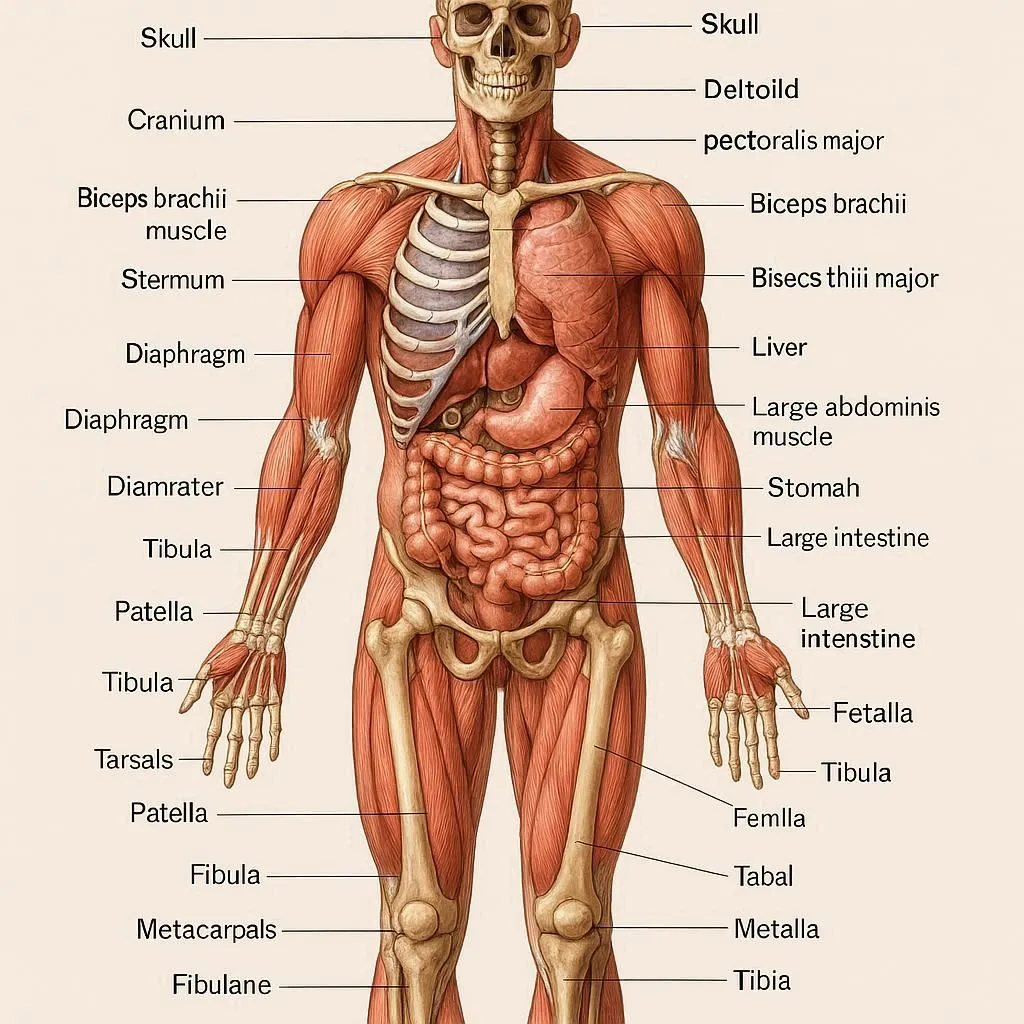
Put your knowledge of anatomy to the test with these Human Body Trivia Questions and Answers! Discover fascinating facts about the brain, heart, bones, muscles, senses, organs, and the amazing systems that keep the human body functioning.
Whether you’re a student, science enthusiast, or trivia fan, these questions offer an entertaining way to learn more about the human body.
Funny Human Body Trivia Questions and Answers
1. What is the largest organ in the human body?
A. Liver
B. Skin
C. Heart
D. Lungs
Correct Answer: B. Skin
Explanation: The skin is the body’s largest organ and provides a protective barrier.
Key Information: It also helps regulate body temperature and allows us to sense touch, pressure, and temperature.
2. Which organ pumps blood throughout the human body?
A. Brain
B. Liver
C. Heart
D. Kidney
Correct Answer: C. Heart
Explanation: The heart is a muscular organ that continuously pumps blood through the circulatory system.
Key Information: The human heart has four chambers.
3. How many bones are typically found in an adult human body?
A. 106
B. 206
C. 306
D. 406
Correct Answer: B. 206
Explanation: A typical adult human skeleton contains 206 bones.
Key Information: Babies are born with more bones, many of which fuse together as they grow.
4. Which organ is primarily responsible for controlling the body’s activities?
A. Brain
B. Stomach
C. Pancreas
D. Spleen
Correct Answer: A. Brain
Explanation: The brain coordinates movement, thoughts, senses, memory, and many automatic body functions.
Key Information: It is the main organ of the central nervous system.
5. Which organs are primarily responsible for taking oxygen into the body?
A. Kidneys
B. Lungs
C. Liver
D. Intestines
Correct Answer: B. Lungs
Explanation: The lungs bring oxygen into the body and remove carbon dioxide during breathing.
Key Information: Gas exchange occurs in tiny structures called alveoli.
6. What is the smallest bone in the human body?
A. Femur
B. Stapes
C. Tibia
D. Radius
Correct Answer: B. Stapes
Explanation: The stapes is a tiny bone located in the middle ear.
Key Information: It helps transmit sound vibrations toward the inner ear.
7. What is the longest bone in the human body?
A. Humerus
B. Femur
C. Tibia
D. Fibula
Correct Answer: B. Femur
Explanation: The femur, or thighbone, is the longest and one of the strongest bones in the human body.
Key Information: It connects the hip to the knee.
8. Which blood cells help fight infections?
A. Red blood cells
B. White blood cells
C. Platelets
D. Plasma cells
Correct Answer: B. White blood cells
Explanation: White blood cells are important components of the immune system and help defend the body against pathogens.
Key Information: There are several types of white blood cells, each with specialized functions.
9. Which blood cells carry oxygen?
A. Red blood cells
B. White blood cells
C. Platelets
D. Stem cells
Correct Answer: A. Red blood cells
Explanation: Red blood cells contain hemoglobin, which binds to oxygen and transports it around the body.
Key Information: Hemoglobin also gives red blood cells their characteristic color.
10. What substance in red blood cells binds oxygen?
A. Insulin
B. Hemoglobin
C. Collagen
D. Keratin
Correct Answer: B. Hemoglobin
Explanation: Hemoglobin is an iron-containing protein that carries oxygen in the blood.
Key Information: It also helps transport some carbon dioxide back toward the lungs.
11. Which organ produces bile?
A. Liver
B. Heart
C. Kidney
D. Pancreas
Correct Answer: A. Liver
Explanation: The liver produces bile, which helps the body digest fats.
Key Information: Bile is stored and concentrated in the gallbladder.
12. Which organs filter waste from the blood and produce urine?
A. Lungs
B. Kidneys
C. Stomach
D. Spleen
Correct Answer: B. Kidneys
Explanation: The kidneys filter the blood and remove excess water and waste products to form urine.
Key Information: Most people have two kidneys.
13. Which organ stores bile?
A. Gallbladder
B. Pancreas
C. Liver
D. Stomach
Correct Answer: A. Gallbladder
Explanation: The gallbladder stores and concentrates bile produced by the liver.
Key Information: Bile is released into the small intestine to assist with fat digestion.
14. Which part of the digestive system absorbs most nutrients from food?
A. Small intestine
B. Large intestine
C. Esophagus
D. Stomach
Correct Answer: A. Small intestine
Explanation: Most nutrient absorption takes place in the small intestine.
Key Information: Its inner surface contains numerous folds and tiny projections called villi.
15. Which organ begins the digestion of food and helps mix it with digestive juices?
A. Stomach
B. Kidney
C. Lung
D. Bladder
Correct Answer: A. Stomach
Explanation: The stomach mechanically churns food and mixes it with gastric juices.
Key Information: Stomach acid helps break down food and contributes to protection against many microbes.
16. Which part of the body contains the vocal cords?
A. Larynx
B. Stomach
C. Trachea
D. Esophagus
Correct Answer: A. Larynx
Explanation: The larynx, or voice box, contains the vocal folds that vibrate to produce sound.
Key Information: The larynx is located in the throat between the pharynx and trachea.
17. Which muscle is primarily responsible for breathing?
A. Diaphragm
B. Biceps
C. Triceps
D. Quadriceps
Correct Answer: A. Diaphragm
Explanation: The diaphragm contracts and relaxes to help draw air into and out of the lungs.
Key Information: It is a dome-shaped muscle located beneath the lungs.
18. Which part of the eye controls how much light enters?
A. Iris
B. Retina
C. Cornea
D. Optic nerve
Correct Answer: A. Iris
Explanation: The iris adjusts the size of the pupil, controlling the amount of light entering the eye.
Key Information: The iris is the colored part of the eye.
19. Which part of the eye contains cells that detect light?
A. Retina
B. Iris
C. Lens
D. Sclera
Correct Answer: A. Retina
Explanation: The retina contains specialized light-sensitive cells called photoreceptors.
Key Information: The retina converts light into electrical signals that are sent to the brain through the optic nerve.
20. Which sense organ is responsible for hearing and balance?
A. Ear
B. Eye
C. Nose
D. Tongue
Correct Answer: A. Ear
Explanation: The ear detects sound and contains structures involved in maintaining balance.
Key Information: The inner ear includes the cochlea for hearing and the vestibular system for balance.
Also See: 136+ Sneaky How to Cheat at DJ Trivia Questions and Answers
Human Body Trivia Questions and Answers for Students
1. Which organ is responsible for filtering waste from the blood?
A. Kidneys
B. Heart
C. Lungs
D. Stomach
Correct Answer: A. Kidneys
Explanation: The kidneys filter the blood and remove waste products and excess substances from the body.
Key Information: Most people have two kidneys, located toward the back of the abdominal cavity.
2. What is the main function of the large intestine?
A. Absorb water and form feces
B. Pump blood
C. Produce oxygen
D. Control movement
Correct Answer: A. Absorb water and form feces
Explanation: The large intestine absorbs water and electrolytes from remaining digestive material.
Key Information: It also houses many microorganisms that contribute to the gut ecosystem.
3. Which organ is primarily responsible for detoxifying and processing many substances in the blood?
A. Liver
B. Heart
C. Spleen
D. Bladder
Correct Answer: A. Liver
Explanation: The liver processes nutrients and helps break down many substances, including certain toxins and medications.
Key Information: It also produces bile and stores several nutrients.
4. Which organ stores urine before it leaves the body?
A. Urinary bladder
B. Kidney
C. Ureter
D. Urethra
Correct Answer: A. Urinary bladder
Explanation: The urinary bladder temporarily stores urine produced by the kidneys.
Key Information: Muscles in the bladder wall help control the release of urine.
5. Which tubes carry urine from the kidneys to the bladder?
A. Ureters
B. Urethra
C. Bronchi
D. Arteries
Correct Answer: A. Ureters
Explanation: The two ureters transport urine from each kidney to the urinary bladder.
Key Information: Muscular contractions in their walls help move urine toward the bladder.
6. Which tube carries urine from the bladder out of the body?
A. Urethra
B. Ureter
C. Esophagus
D. Trachea
Correct Answer: A. Urethra
Explanation: The urethra is the passage through which urine exits the body.
Key Information: It is different from the ureters, which connect the kidneys to the bladder.
7. Which structure prevents food from entering the windpipe during swallowing?
A. Epiglottis
B. Diaphragm
C. Pancreas
D. Tonsil
Correct Answer: A. Epiglottis
Explanation: The epiglottis is a flap of tissue that helps cover the airway during swallowing.
Key Information: This helps direct food and liquid toward the esophagus instead of the trachea.
8. What is the windpipe commonly called?
A. Trachea
B. Esophagus
C. Larynx
D. Bronchiole
Correct Answer: A. Trachea
Explanation: The trachea is the airway that connects the larynx to the bronchi.
Key Information: It is supported by rings of cartilage that help keep the airway open.
9. Which tube carries food from the throat to the stomach?
A. Esophagus
B. Trachea
C. Ureter
D. Bronchus
Correct Answer: A. Esophagus
Explanation: The esophagus transports swallowed food and liquids toward the stomach.
Key Information: Rhythmic muscular contractions called peristalsis help move food through it.
10. What is the name of the muscular movement that pushes food through the digestive tract?
A. Peristalsis
B. Respiration
C. Filtration
D. Circulation
Correct Answer: A. Peristalsis
Explanation: Peristalsis consists of coordinated waves of muscular contraction that move food through the digestive system.
Key Information: This movement occurs in several parts of the digestive tract.
11. Which organ is primarily responsible for producing digestive enzymes and insulin?
A. Pancreas
B. Spleen
C. Gallbladder
D. Thyroid
Correct Answer: A. Pancreas
Explanation: The pancreas produces digestive enzymes and hormones such as insulin.
Key Information: It therefore has both digestive and endocrine functions.
12. Which organ is part of the immune system and helps filter blood?
A. Spleen
B. Stomach
C. Bladder
D. Thyroid
Correct Answer: A. Spleen
Explanation: The spleen filters blood and supports immune functions.
Key Information: It can also help remove old or damaged blood cells from circulation.
13. Which body system includes the brain, spinal cord, and nerves?
A. Nervous system
B. Digestive system
C. Respiratory system
D. Skeletal system
Correct Answer: A. Nervous system
Explanation: The nervous system receives information, processes it, and coordinates many body activities.
Key Information: It is divided into the central and peripheral nervous systems.
14. Which body system is responsible for transporting blood throughout the body?
A. Circulatory system
B. Digestive system
C. Respiratory system
D. Integumentary system
Correct Answer: A. Circulatory system
Explanation: The circulatory system moves blood, oxygen, nutrients, hormones, and waste products throughout the body.
Key Information: Its major components include the heart, blood, and blood vessels.
15. Which blood vessels carry blood away from the heart?
A. Arteries
B. Veins
C. Capillaries
D. Venules
Correct Answer: A. Arteries
Explanation: Arteries carry blood away from the heart.
Key Information: Most arteries carry oxygen-rich blood, although the pulmonary arteries are an important exception.
16. Which blood vessels return blood toward the heart?
A. Veins
B. Arteries
C. Capillaries
D. Arterioles
Correct Answer: A. Veins
Explanation: Veins carry blood back toward the heart.
Key Information: Many veins contain valves that help prevent blood from flowing backward.
17. Which tiny blood vessels allow exchanges of oxygen, nutrients, and waste with tissues?
A. Capillaries
B. Arteries
C. Veins
D. Aorta
Correct Answer: A. Capillaries
Explanation: Capillaries have extremely thin walls that allow substances to move between blood and surrounding tissues.
Key Information: They connect the smallest arteries with the smallest veins.
18. What is the largest artery in the human body?
A. Aorta
B. Pulmonary artery
C. Carotid artery
D. Femoral artery
Correct Answer: A. Aorta
Explanation: The aorta is the main artery carrying oxygen-rich blood from the heart to the body.
Key Information: It branches into numerous arteries that supply different regions of the body.
19. Which body system provides the framework and support for the body?
A. Skeletal system
B. Nervous system
C. Digestive system
D. Endocrine system
Correct Answer: A. Skeletal system
Explanation: The skeletal system provides structural support and protects many internal organs.
Key Information: Bones also serve as attachment points for muscles and contain bone marrow.
20. Which body system allows the body to move by contracting muscles?
A. Muscular system
B. Respiratory system
C. Urinary system
D. Lymphatic system
Correct Answer: A. Muscular system
Explanation: Muscles contract to produce movement and help maintain posture.
Key Information: The muscular system works closely with the skeletal and nervous systems.
Related: 136+ Fish Trivia Questions and Answers
Human Body Trivia Questions and Answers for Adults
1. Which part of the brain is responsible for many higher functions such as thinking, memory, and voluntary movement?
A. Cerebrum
B. Cerebellum
C. Medulla
D. Spinal cord
Correct Answer: A. Cerebrum
Explanation: The cerebrum is the largest part of the brain and handles many complex mental and voluntary activities.
Key Information: It is divided into two hemispheres, commonly called the left and right hemispheres.
2. Which part of the brain helps regulate breathing and heart rate automatically?
A. Medulla oblongata
B. Cerebellum
C. Frontal lobe
D. Hippocampus
Correct Answer: A. Medulla oblongata
Explanation: The medulla oblongata controls several vital involuntary functions.
Key Information: It is part of the brainstem and helps regulate breathing, heart activity, and blood pressure.
3. Which part of the brain is strongly associated with forming and organizing memories?
A. Hippocampus
B. Medulla
C. Cerebellum
D. Pons
Correct Answer: A. Hippocampus
Explanation: The hippocampus plays an important role in learning and the formation of new memories.
Key Information: There is a hippocampus in each side of the brain.
4. Which lobe of the brain is primarily associated with processing visual information?
A. Occipital lobe
B. Frontal lobe
C. Temporal lobe
D. Parietal lobe
Correct Answer: A. Occipital lobe
Explanation: The occipital lobe contains areas involved in processing information received from the eyes.
Key Information: It is located toward the back of the brain.
5. Which lobe is associated with hearing and processing many aspects of sound?
A. Temporal lobe
B. Occipital lobe
C. Parietal lobe
D. Frontal lobe
Correct Answer: A. Temporal lobe
Explanation: The temporal lobes contain important areas involved in hearing and language processing.
Key Information: They are located on the sides of the brain near the ears.
6. Which lobe is strongly involved in planning, decision-making, and voluntary movement?
A. Frontal lobe
B. Occipital lobe
C. Temporal lobe
D. Parietal lobe
Correct Answer: A. Frontal lobe
Explanation: The frontal lobe contributes to planning, reasoning, decision-making, and voluntary motor control.
Key Information: It is located at the front portion of the cerebrum.
7. Which lobe helps process touch, temperature, and spatial information?
A. Parietal lobe
B. Temporal lobe
C. Occipital lobe
D. Frontal lobe
Correct Answer: A. Parietal lobe
Explanation: The parietal lobe contains regions that process sensory information from the body.
Key Information: It also contributes to spatial awareness and interpreting the position of objects.
8. Which structure connects the two cerebral hemispheres?
A. Corpus callosum
B. Pituitary gland
C. Brainstem
D. Amygdala
Correct Answer: A. Corpus callosum
Explanation: The corpus callosum is a large bundle of nerve fibers connecting the left and right cerebral hemispheres.
Key Information: It allows information to be shared between the two sides of the brain.
9. Which structure in the inner ear is mainly responsible for hearing?
A. Cochlea
B. Eardrum
C. Pinna
D. Semicircular canal
Correct Answer: A. Cochlea
Explanation: The cochlea converts sound vibrations into nerve signals that can be processed by the brain.
Key Information: It is a spiral-shaped structure filled with fluid.
10. Which structure in the ear helps detect head movement and maintain balance?
A. Semicircular canals
B. Eardrum
C. Cochlea
D. Ear canal
Correct Answer: A. Semicircular canals
Explanation: The semicircular canals detect rotational movements of the head.
Key Information: They are part of the vestibular system in the inner ear.
11. Which transparent structure at the front of the eye helps focus incoming light?
A. Cornea
B. Retina
C. Iris
D. Optic nerve
Correct Answer: A. Cornea
Explanation: The cornea is a transparent curved surface that provides much of the eye’s focusing power.
Key Information: It also helps protect the eye from dust and other external particles.
12. Which structure changes shape to focus light onto the retina?
A. Lens
B. Iris
C. Sclera
D. Optic nerve
Correct Answer: A. Lens
Explanation: The lens changes its shape to focus images at different distances.
Key Information: This focusing process is called accommodation.
13. Which part of the eye carries visual signals toward the brain?
A. Optic nerve
B. Cornea
C. Iris
D. Lens
Correct Answer: A. Optic nerve
Explanation: The optic nerve transmits electrical signals from the retina to the brain.
Key Information: The brain interprets these signals as visual information.
14. Which structure is commonly called the “voice box”?
A. Larynx
B. Pharynx
C. Trachea
D. Bronchus
Correct Answer: A. Larynx
Explanation: The larynx contains the vocal folds and plays an important role in producing sound.
Key Information: It also helps protect the airway during swallowing.
15. Which tiny air sacs in the lungs are the main sites of gas exchange?
A. Alveoli
B. Bronchi
C. Trachea
D. Pleura
Correct Answer: A. Alveoli
Explanation: Oxygen moves from the alveoli into nearby blood vessels while carbon dioxide moves in the opposite direction.
Key Information: The lungs contain millions of these microscopic air sacs.
16. Which structures carry air from the trachea into the lungs?
A. Bronchi
B. Alveoli
C. Capillaries
D. Ureters
Correct Answer: A. Bronchi
Explanation: The trachea divides into two main bronchi, one leading to each lung.
Key Information: The bronchi branch into progressively smaller airways called bronchioles.
17. Which muscle group helps move the skeleton by pulling on bones?
A. Skeletal muscles
B. Cardiac muscles
C. Smooth muscles
D. Glandular tissues
Correct Answer: A. Skeletal muscles
Explanation: Skeletal muscles attach to bones and contract to create voluntary body movements.
Key Information: They also help maintain posture and stabilize joints.
18. Which type of muscle is found in the walls of organs such as the stomach and intestines?
A. Smooth muscle
B. Skeletal muscle
C. Cardiac muscle
D. Voluntary muscle
Correct Answer: A. Smooth muscle
Explanation: Smooth muscle controls involuntary movements inside many hollow organs.
Key Information: It helps move substances through structures such as the digestive tract.
19. Which type of muscle makes up most of the heart?
A. Cardiac muscle
B. Smooth muscle
C. Skeletal muscle
D. Connective muscle
Correct Answer: A. Cardiac muscle
Explanation: Cardiac muscle is specialized muscle tissue that contracts continuously to pump blood.
Key Information: It is found specifically in the heart and works involuntarily.
20. Which connective tissue cushions and protects the ends of many bones at joints?
A. Cartilage
B. Tendon
C. Ligament
D. Muscle fiber
Correct Answer: A. Cartilage
Explanation: Cartilage provides a smooth, resilient surface that helps reduce friction between bones at many joints.
Key Information: It also provides flexible support in structures such as the nose and outer ear.
Related: 146+ Parks and Recreation Trivia Questions and Answers
Human Body Trivia Questions and Answers for Hard
1. Which part of the tooth is the hardest substance in the human body?
A. Enamel
B. Dentin
C. Pulp
D. Cementum
Correct Answer: A. Enamel
Explanation: Enamel is the hard outer covering of a tooth and protects it from daily wear.
Key Information: Tooth enamel is highly mineralized and is even harder than bone.
2. Which part of a tooth contains nerves and blood vessels?
A. Pulp
B. Enamel
C. Dentin
D. Crown
Correct Answer: A. Pulp
Explanation: The pulp is the innermost part of a tooth and contains nerves, blood vessels, and connective tissue.
Key Information: Damage reaching the pulp can cause significant tooth sensitivity or pain.
3. How many permanent teeth does a typical adult have, including wisdom teeth?
A. 28
B. 30
C. 32
D. 36
Correct Answer: C. 32
Explanation: A typical adult has 32 permanent teeth when all four wisdom teeth are present.
Key Information: The 32 teeth include incisors, canines, premolars, and molars.
4. Which teeth are primarily used for cutting and biting food?
A. Incisors
B. Molars
C. Premolars
D. Wisdom teeth
Correct Answer: A. Incisors
Explanation: Incisors are the flat, sharp-edged teeth at the front of the mouth.
Key Information: Adults normally have eight incisors.
5. Which teeth are mainly adapted for tearing food?
A. Canines
B. Incisors
C. Molars
D. Premolars
Correct Answer: A. Canines
Explanation: Canines are pointed teeth designed to help grip and tear food.
Key Information: Most adults have four permanent canines.
6. Which teeth are especially important for grinding food?
A. Molars
B. Incisors
C. Canines
D. Wisdom teeth only
Correct Answer: A. Molars
Explanation: Molars have broad surfaces that are well suited for crushing and grinding food.
Key Information: Wisdom teeth are the third set of molars.
7. What is the medical term for the voice-producing folds in the larynx?
A. Vocal folds
B. Nasal folds
C. Lung folds
D. Pharyngeal cords
Correct Answer: A. Vocal folds
Explanation: Vocal folds vibrate as air passes through the larynx, producing sound.
Key Information: Their vibration can be adjusted to create different pitches.
8. Which body structure separates the chest cavity from the abdominal cavity?
A. Diaphragm
B. Sternum
C. Pelvis
D. Esophagus
Correct Answer: A. Diaphragm
Explanation: The diaphragm is a large muscle located beneath the lungs.
Key Information: Its movement is essential for normal breathing.
9. Which organ is mainly responsible for absorbing water from undigested food?
A. Large intestine
B. Stomach
C. Small intestine
D. Pancreas
Correct Answer: A. Large intestine
Explanation: The large intestine absorbs water and certain electrolytes from digestive contents.
Key Information: This process helps transform liquid intestinal contents into more solid fecal matter.
10. What is the muscular tube that connects the throat to the stomach?
A. Esophagus
B. Trachea
C. Ureter
D. Bronchus
Correct Answer: A. Esophagus
Explanation: The esophagus transports swallowed food and liquid toward the stomach.
Key Information: Peristaltic contractions push material downward.
11. Which organ produces most of the body’s bile?
A. Liver
B. Gallbladder
C. Pancreas
D. Stomach
Correct Answer: A. Liver
Explanation: The liver continuously produces bile, which assists in the digestion and absorption of fats.
Key Information: The gallbladder stores and concentrates bile before releasing it.
12. Which organ is primarily responsible for storing and concentrating bile?
A. Gallbladder
B. Liver
C. Pancreas
D. Spleen
Correct Answer: A. Gallbladder
Explanation: The gallbladder stores bile produced by the liver and releases it when needed.
Key Information: Bile enters the small intestine during digestion.
13. Which structure connects the mouth to the throat and plays a role in both breathing and swallowing?
A. Pharynx
B. Ureter
C. Bronchiole
D. Pancreas
Correct Answer: A. Pharynx
Explanation: The pharynx is a passageway shared by the respiratory and digestive systems.
Key Information: It lies behind the nose and mouth and leads toward the larynx and esophagus.
14. Which body fluid helps lubricate the eyes and keep their surface moist?
A. Tears
B. Bile
C. Plasma
D. Lymph
Correct Answer: A. Tears
Explanation: Tears form a protective film over the surface of the eyes.
Key Information: Tears also contain substances that help protect the eyes from microorganisms.
15. Which glands produce tears?
A. Lacrimal glands
B. Thyroid glands
C. Adrenal glands
D. Salivary glands
Correct Answer: A. Lacrimal glands
Explanation: Lacrimal glands produce the watery component of tears.
Key Information: They are located above and toward the outer side of each eye.
16. Which glands produce saliva in the mouth?
A. Salivary glands
B. Sweat glands
C. Adrenal glands
D. Thyroid glands
Correct Answer: A. Salivary glands
Explanation: Salivary glands release saliva, which helps moisten food and begins digestion.
Key Information: Humans have several major salivary glands, including the parotid, submandibular, and sublingual glands.
17. Which enzyme in saliva begins the digestion of starch?
A. Amylase
B. Pepsin
C. Lipase
D. Trypsin
Correct Answer: A. Amylase
Explanation: Salivary amylase begins breaking down starch into smaller carbohydrate molecules.
Key Information: Digestion of carbohydrates continues farther along the digestive tract.
18. Which enzyme in the stomach helps break down proteins?
A. Pepsin
B. Amylase
C. Lactase
D. Maltase
Correct Answer: A. Pepsin
Explanation: Pepsin is a digestive enzyme that breaks proteins into smaller peptides.
Key Information: It becomes active in the acidic environment of the stomach.
19. Which vitamin can the human body produce when skin is exposed to sunlight?
A. Vitamin D
B. Vitamin C
C. Vitamin B12
D. Vitamin K
Correct Answer: A. Vitamin D
Explanation: Sunlight exposure can trigger vitamin D production in the skin.
Key Information: Vitamin D is important for calcium absorption and healthy bones.
20. Which mineral is especially important for building and maintaining strong bones and teeth?
A. Calcium
B. Sodium
C. Potassium
D. Iodine
Correct Answer: A. Calcium
Explanation: Calcium is a major mineral component of bones and teeth.
Key Information: Calcium also plays important roles in muscle contraction, nerve signaling, and blood clotting.
Best Human Body Trivia Questions and Answers
1. Which part of the blood is mostly made up of water and carries dissolved substances?
A. Plasma
B. Platelets
C. Hemoglobin
D. Red blood cells
Correct Answer: A. Plasma
Explanation: Plasma is the liquid component of blood and carries nutrients, hormones, proteins, and waste products.
Key Information: Plasma makes up more than half of the total volume of blood.
2. Which blood group is known as the universal red-cell donor type?
A. AB positive
B. O negative
C. A positive
D. B negative
Correct Answer: B. O negative
Explanation: O-negative red blood cells lack A, B, and Rh(D) antigens, making them broadly compatible for emergency red-cell transfusions.
Key Information: Blood compatibility still depends on the specific transfusion situation.
3. Which blood group is commonly called the universal plasma donor?
A. O negative
B. AB
C. A
D. B
Correct Answer: B. AB
Explanation: AB plasma does not contain anti-A or anti-B antibodies, making it broadly compatible as donor plasma.
Key Information: Plasma compatibility works differently from red-blood-cell compatibility.
4. Which protein helps give skin, hair, and nails their strength?
A. Keratin
B. Hemoglobin
C. Insulin
D. Collagen
Correct Answer: A. Keratin
Explanation: Keratin is a tough structural protein found in the outer layers of skin and in hair and nails.
Key Information: It helps protect tissues from physical stress.
5. Which protein provides much of the structural strength and flexibility of connective tissues?
A. Collagen
B. Insulin
C. Hemoglobin
D. Myosin
Correct Answer: A. Collagen
Explanation: Collagen is a major structural protein found in skin, tendons, ligaments, cartilage, and other tissues.
Key Information: It is one of the most abundant proteins in the human body.
6. Which protein in muscles interacts with actin to help produce contraction?
A. Myosin
B. Keratin
C. Elastin
D. Hemoglobin
Correct Answer: A. Myosin
Explanation: Myosin is a motor protein that interacts with actin during muscle contraction.
Key Information: The interaction between actin and myosin generates force within muscle fibers.
7. Which molecule is often described as the main energy currency of cells?
A. ATP
B. DNA
C. RNA
D. Glucose
Correct Answer: A. ATP
Explanation: ATP stores and transfers usable energy for many cellular processes.
Key Information: Cells continually produce and use ATP to power activities.
8. Which organelle is often called the powerhouse of the cell?
A. Mitochondrion
B. Nucleus
C. Ribosome
D. Lysosome
Correct Answer: A. Mitochondrion
Explanation: Mitochondria generate much of the ATP used by cells.
Key Information: Most cells contain many mitochondria, although their numbers vary by cell type.
9. Which structure contains most of a cell’s genetic material?
A. Nucleus
B. Ribosome
C. Cell membrane
D. Cytoplasm
Correct Answer: A. Nucleus
Explanation: In human cells, most DNA is contained within the nucleus.
Key Information: A small amount of DNA is also found inside mitochondria.
10. What molecule carries the genetic instructions used to build and maintain the human body?
A. DNA
B. ATP
C. Glucose
D. Cholesterol
Correct Answer: A. DNA
Explanation: DNA stores hereditary information and contains instructions important for cellular functions.
Key Information: Human DNA is organized into chromosomes inside the cell nucleus.
11. How many pairs of chromosomes are normally found in human body cells?
A. 22
B. 23
C. 24
D. 46
Correct Answer: B. 23
Explanation: Most human body cells contain 23 pairs of chromosomes, for a total of 46 chromosomes.
Key Information: One chromosome of each pair is inherited from each biological parent.
12. Which molecule carries genetic instructions from DNA to ribosomes for protein production?
A. Messenger RNA
B. ATP
C. Collagen
D. Hemoglobin
Correct Answer: A. Messenger RNA
Explanation: Messenger RNA, or mRNA, carries genetic information from DNA to ribosomes.
Key Information: Ribosomes use the information in mRNA to assemble proteins.
13. Which structures are responsible for making proteins inside cells?
A. Ribosomes
B. Lysosomes
C. Centrioles
D. Mitochondria
Correct Answer: A. Ribosomes
Explanation: Ribosomes assemble amino acids into proteins according to instructions carried by messenger RNA.
Key Information: Ribosomes can be found either free in the cell or attached to the rough endoplasmic reticulum.
14. Which organelle helps digest and recycle cellular waste?
A. Lysosome
B. Nucleus
C. Ribosome
D. Centriole
Correct Answer: A. Lysosome
Explanation: Lysosomes contain enzymes that break down various cellular materials.
Key Information: They help cells recycle damaged components and unwanted substances.
15. Which structure controls what enters and leaves a cell?
A. Cell membrane
B. Nucleus
C. Ribosome
D. Chromosome
Correct Answer: A. Cell membrane
Explanation: The cell membrane forms a selective barrier around the cell.
Key Information: It helps maintain the cell’s internal environment by regulating the movement of substances.
16. Which process allows cells to divide and produce two genetically similar daughter cells?
A. Mitosis
B. Digestion
C. Respiration
D. Filtration
Correct Answer: A. Mitosis
Explanation: Mitosis is a type of cell division that produces two daughter cells with matching sets of chromosomes.
Key Information: It is important for growth, development, and tissue repair.
17. Which type of cell division produces eggs and sperm?
A. Meiosis
B. Mitosis
C. Diffusion
D. Osmosis
Correct Answer: A. Meiosis
Explanation: Meiosis produces reproductive cells with half the usual number of chromosomes.
Key Information: It also creates genetic variation through processes such as crossing over.
18. Which process describes the movement of molecules from an area of higher concentration to an area of lower concentration?
A. Diffusion
B. Digestion
C. Filtration
D. Contraction
Correct Answer: A. Diffusion
Explanation: Diffusion occurs when particles move down a concentration gradient.
Key Information: It is an important process for the movement of substances across biological membranes.
19. Which process specifically involves water moving across a selectively permeable membrane?
A. Osmosis
B. Mitosis
C. Respiration
D. Absorption
Correct Answer: A. Osmosis
Explanation: Osmosis is the movement of water across a selectively permeable membrane toward an area with a higher concentration of dissolved substances.
Key Information: Osmosis helps cells maintain appropriate water balance.
20. Which system helps return excess fluid from tissues to the bloodstream and supports immune function?
A. Lymphatic system
B. Skeletal system
C. Digestive system
D. Muscular system
Correct Answer: A. Lymphatic system
Explanation: The lymphatic system collects excess tissue fluid and returns it to the circulation while also participating in immune defense.
Key Information: Lymph nodes are important structures within this system.
Human Body Trivia Questions and Answers for Kids
1. Which structure in the human body connects muscles to bones?
A. Tendon
B. Ligament
C. Cartilage
D. Nerve
Correct Answer: A. Tendon
Explanation: Tendons are strong bands of connective tissue that attach muscles to bones.
Key Information: They transmit the force produced by muscles to move bones.
2. Which connective tissue connects bone to bone?
A. Ligament
B. Tendon
C. Cartilage
D. Fascia
Correct Answer: A. Ligament
Explanation: Ligaments connect bones and help stabilize joints.
Key Information: They are made primarily of strong collagen fibers.
3. Which structure surrounds and protects the brain?
A. Skull
B. Sternum
C. Pelvis
D. Rib cage
Correct Answer: A. Skull
Explanation: The skull provides a hard protective covering around the brain.
Key Information: The skull is made up of multiple bones that form the cranium and facial skeleton.
4. What is the protective fluid surrounding the brain and spinal cord called?
A. Cerebrospinal fluid
B. Plasma
C. Lymph
D. Synovial fluid
Correct Answer: A. Cerebrospinal fluid
Explanation: Cerebrospinal fluid cushions the brain and spinal cord and helps provide a stable environment for the nervous system.
Key Information: It circulates through spaces around and within the brain and spinal cord.
5. Which membranes protect the brain and spinal cord?
A. Meninges
B. Alveoli
C. Pleura
D. Tendons
Correct Answer: A. Meninges
Explanation: The meninges are layers of protective tissue surrounding the brain and spinal cord.
Key Information: There are three main layers: dura mater, arachnoid mater, and pia mater.
6. Which part of the skeleton forms the central supporting framework of the body?
A. Axial skeleton
B. Appendicular skeleton
C. Pelvic girdle
D. Shoulder girdle
Correct Answer: A. Axial skeleton
Explanation: The axial skeleton includes the skull, vertebral column, ribs, and sternum.
Key Information: It provides support and protects important organs such as the brain, heart, and lungs.
7. Which group of bones forms the backbone?
A. Vertebrae
B. Carpals
C. Tarsals
D. Metatarsals
Correct Answer: A. Vertebrae
Explanation: The vertebrae are the individual bones that make up the vertebral column.
Key Information: They surround and protect the spinal cord.
8. Which bone is commonly called the breastbone?
A. Sternum
B. Scapula
C. Clavicle
D. Pelvis
Correct Answer: A. Sternum
Explanation: The sternum is a flat bone located in the center of the chest.
Key Information: Several ribs connect to the sternum through cartilage.
9. Which part of the skeleton contains the bones of the hands and feet?
A. Appendicular skeleton
B. Axial skeleton
C. Cranial skeleton
D. Vertebral skeleton
Correct Answer: A. Appendicular skeleton
Explanation: The appendicular skeleton includes the limbs and the bones that connect them to the body’s central framework.
Key Information: It allows a wide range of movement.
10. How many bones are normally found in one human hand, including the wrist bones?
A. 27
B. 25
C. 29
D. 31
Correct Answer: A. 27
Explanation: Each hand normally contains 27 bones.
Key Information: These include 8 wrist bones, 5 metacarpals, and 14 finger bones.
11. How many bones are normally found in one human foot?
A. 26
B. 24
C. 28
D. 30
Correct Answer: A. 26
Explanation: Each human foot normally contains 26 bones.
Key Information: These include 7 tarsal bones, 5 metatarsals, and 14 toe bones.
12. Which muscles are attached to the skeleton and usually under conscious control?
A. Skeletal muscles
B. Smooth muscles
C. Cardiac muscles
D. Visceral muscles
Correct Answer: A. Skeletal muscles
Explanation: Skeletal muscles attach to bones and are generally responsible for voluntary movement.
Key Information: They also help maintain posture and produce body heat.
13. Which type of body tissue covers surfaces and lines many internal organs?
A. Epithelial tissue
B. Muscle tissue
C. Nervous tissue
D. Bone tissue
Correct Answer: A. Epithelial tissue
Explanation: Epithelial tissue covers external surfaces and lines many organs and body cavities.
Key Information: It can provide protection, absorption, secretion, and other functions.
14. Which type of tissue carries electrical signals throughout the nervous system?
A. Nervous tissue
B. Epithelial tissue
C. Adipose tissue
D. Cartilage
Correct Answer: A. Nervous tissue
Explanation: Nervous tissue contains cells specialized for receiving, processing, and transmitting information.
Key Information: Neurons are the primary signaling cells of nervous tissue.
15. Which cells are the main signaling cells of the nervous system?
A. Neurons
B. Platelets
C. Osteocytes
D. Red blood cells
Correct Answer: A. Neurons
Explanation: Neurons transmit electrical and chemical signals throughout the nervous system.
Key Information: Neurons communicate with one another at specialized junctions called synapses.
16. Which cells provide support and protection for neurons?
A. Glial cells
B. Red blood cells
C. Platelets
D. Osteoblasts
Correct Answer: A. Glial cells
Explanation: Glial cells support neurons in several ways, including providing nutrients, protection, and insulation.
Key Information: Different types of glial cells perform different functions in the brain, spinal cord, and peripheral nerves.
17. Which structure is responsible for transmitting signals between neurons?
A. Synapse
B. Tendon
C. Alveolus
D. Nephron
Correct Answer: A. Synapse
Explanation: A synapse is a junction where one neuron communicates with another cell.
Key Information: Many synapses use chemical messengers called neurotransmitters.
18. Which structure is the basic functional unit of the kidney?
A. Nephron
B. Neuron
C. Alveolus
D. Villus
Correct Answer: A. Nephron
Explanation: Nephrons filter blood and help regulate water, salts, and waste products to form urine.
Key Information: Each kidney contains a very large number of nephrons.
19. Which tiny structures in the small intestine increase the surface area for nutrient absorption?
A. Villi
B. Alveoli
C. Nephrons
D. Bronchioles
Correct Answer: A. Villi
Explanation: Villi are tiny finger-like projections lining the small intestine that increase its absorptive surface area.
Key Information: Each villus contains blood vessels and a lymphatic vessel that help transport absorbed nutrients.
20. Which tiny structures in the lungs provide a large surface area for gas exchange?
A. Alveoli
B. Villi
C. Nephrons
D. Neurons
Correct Answer: A. Alveoli
Explanation: Alveoli are microscopic air sacs where oxygen and carbon dioxide are exchanged between air and blood.
Key Information: Their enormous combined surface area makes efficient gas exchange possible.
Easy Body Trivia Questions and Answers for Kids
1. Which part of the blood helps transport oxygen using a protein called hemoglobin?
A. Red blood cells
B. White blood cells
C. Platelets
D. Plasma
Correct Answer: A. Red blood cells
Explanation: Red blood cells contain hemoglobin, which binds oxygen and carries it through the bloodstream.
Key Information: Red blood cells are also called erythrocytes.
2. Which organ helps regulate body temperature by producing sweat?
A. Skin
B. Liver
C. Pancreas
D. Spleen
Correct Answer: A. Skin
Explanation: Sweat glands in the skin produce sweat, which can cool the body as it evaporates.
Key Information: The skin also helps protect the body from the external environment.
3. Which type of gland releases substances through ducts onto body surfaces or into body cavities?
A. Exocrine gland
B. Endocrine gland
C. Lymph gland
D. Pituitary gland
Correct Answer: A. Exocrine gland
Explanation: Exocrine glands release substances through ducts, such as sweat, saliva, and digestive enzymes.
Key Information: Endocrine glands instead release hormones directly into the bloodstream.
4. Which type of gland releases hormones directly into the bloodstream?
A. Endocrine gland
B. Exocrine gland
C. Sweat gland
D. Salivary gland
Correct Answer: A. Endocrine gland
Explanation: Endocrine glands produce hormones and release them into the blood.
Key Information: Examples include the thyroid, adrenal, and pituitary glands.
5. Which hormone is commonly associated with the body’s “fight-or-flight” response?
A. Adrenaline
B. Insulin
C. Melatonin
D. Estrogen
Correct Answer: A. Adrenaline
Explanation: Adrenaline helps prepare the body for rapid action during stressful or threatening situations.
Key Information: It can increase heart rate and redirect blood flow toward muscles.
6. Which hormone is strongly associated with regulating the sleep-wake cycle?
A. Melatonin
B. Insulin
C. Adrenaline
D. Glucagon
Correct Answer: A. Melatonin
Explanation: Melatonin is a hormone that helps regulate the body’s circadian rhythm.
Key Information: The pineal gland produces melatonin, with production generally increasing in darkness.
7. Which gland produces melatonin?
A. Pineal gland
B. Thyroid gland
C. Adrenal gland
D. Pancreas
Correct Answer: A. Pineal gland
Explanation: The pineal gland produces melatonin, which helps regulate sleep timing.
Key Information: It is a small endocrine gland located deep within the brain.
8. Which body system produces hormones that regulate many long-term processes?
A. Endocrine system
B. Skeletal system
C. Respiratory system
D. Digestive system
Correct Answer: A. Endocrine system
Explanation: The endocrine system consists of glands and tissues that produce hormones.
Key Information: Hormones influence processes such as growth, metabolism, reproduction, and stress responses.
9. Which organ is primarily responsible for breaking down many medications and chemicals?
A. Liver
B. Heart
C. Bladder
D. Lung
Correct Answer: A. Liver
Explanation: The liver chemically processes many substances absorbed into the bloodstream.
Key Information: This process is important in how the body handles medicines and other compounds.
10. Which substance produced by the liver helps emulsify fats during digestion?
A. Bile
B. Insulin
C. Saliva
D. Mucus
Correct Answer: A. Bile
Explanation: Bile breaks large fat droplets into smaller droplets, making fats easier for digestive enzymes to process.
Key Information: Bile is stored in the gallbladder before being released into the small intestine.
11. Which organ produces hydrochloric acid as part of digestion?
A. Stomach
B. Liver
C. Pancreas
D. Large intestine
Correct Answer: A. Stomach
Explanation: Specialized cells in the stomach lining secrete hydrochloric acid, contributing to digestion.
Key Information: The stomach lining has protective mechanisms that help shield it from its acidic contents.
12. Which substance in the stomach helps protect its lining from digestive acid?
A. Mucus
B. Bile
C. Insulin
D. Hemoglobin
Correct Answer: A. Mucus
Explanation: A mucus layer helps protect the stomach lining from acid and digestive enzymes.
Key Information: The stomach lining continually renews itself to maintain this protective barrier.
13. Which organ produces digestive enzymes that help break down carbohydrates, proteins, and fats?
A. Pancreas
B. Spleen
C. Thyroid
D. Bladder
Correct Answer: A. Pancreas
Explanation: The pancreas releases several digestive enzymes into the small intestine.
Key Information: These enzymes include pancreatic amylase, lipase, and proteases.
14. Which structure is the main site where nutrients enter the bloodstream after digestion?
A. Small intestine
B. Esophagus
C. Stomach
D. Large intestine
Correct Answer: A. Small intestine
Explanation: The small intestine absorbs most digested nutrients through its highly specialized lining.
Key Information: Villi and microvilli greatly increase the surface area available for absorption.
15. Which tiny projections cover the surface of intestinal cells and further increase absorption area?
A. Microvilli
B. Alveoli
C. Nephrons
D. Synapses
Correct Answer: A. Microvilli
Explanation: Microvilli are microscopic projections on intestinal cells that greatly increase the surface area available for nutrient absorption.
Key Information: Together, microvilli form a brush border on many intestinal cells.
16. Which organ helps maintain the body’s fluid and electrolyte balance?
A. Kidneys
B. Appendix
C. Gallbladder
D. Esophagus
Correct Answer: A. Kidneys
Explanation: The kidneys regulate water, electrolytes, and several important substances in the blood.
Key Information: They also help regulate blood pressure and contribute to red blood cell production through hormone signaling.
17. Which hormone produced by the kidneys stimulates red blood cell production?
A. Erythropoietin
B. Insulin
C. Melatonin
D. Thyroxine
Correct Answer: A. Erythropoietin
Explanation: The kidneys produce erythropoietin, which signals the bone marrow to increase red blood cell production when needed.
Key Information: Low oxygen levels can stimulate increased erythropoietin production.
18. Which organ helps regulate calcium levels by activating vitamin D?
A. Kidneys
B. Stomach
C. Spleen
D. Gallbladder
Correct Answer: A. Kidneys
Explanation: The kidneys convert vitamin D into its active form, which supports calcium absorption and regulation.
Key Information: Calcium is essential for bones, muscles, nerves, and other body functions.
19. Which body system helps defend the body against pathogens and abnormal cells?
A. Immune system
B. Digestive system
C. Skeletal system
D. Muscular system
Correct Answer: A. Immune system
Explanation: The immune system uses cells, tissues, organs, and molecules to identify and respond to potential threats.
Key Information: White blood cells are among its major cellular components.
20. Which structures filter lymph and contain immune cells?
A. Lymph nodes
B. Alveoli
C. Nephrons
D. Tendons
Correct Answer: A. Lymph nodes
Explanation: Lymph nodes filter lymph and provide sites where immune cells can detect and respond to foreign substances.
Key Information: They are distributed throughout the body and are connected by lymphatic vessels.
FAQS
1. What are Human Body Trivia Questions and Answers?
Human Body Trivia Questions and Answers are quiz questions about the anatomy, organs, bones, muscles, senses, and fascinating functions of the human body.
2. What topics are covered in Human Body Trivia?
Questions can cover the brain, heart, lungs, bones, muscles, digestive system, nervous system, senses, blood, and other parts and functions of the human body.
3. Who can enjoy Human Body Trivia?
Human Body Trivia is great for students, teachers, families, and anyone interested in learning interesting facts about human anatomy and biology.
4. How can I make Human Body Trivia more challenging?
Include questions about lesser-known organs, biological processes, anatomy terms, body systems, and unusual human-body facts to challenge experienced trivia players.
Conclusion
These Human Body Trivia Questions and Answers provide a fun opportunity to explore the incredible complexity of human anatomy.
From major organs and body systems to surprising biological facts, there’s plenty to discover and learn.
Challenge yourself, share the quiz with friends, and see how much you really know about the human body!